China’s Corruption Watchdog Investigates Emergency Management Minister Wang Xiangxi
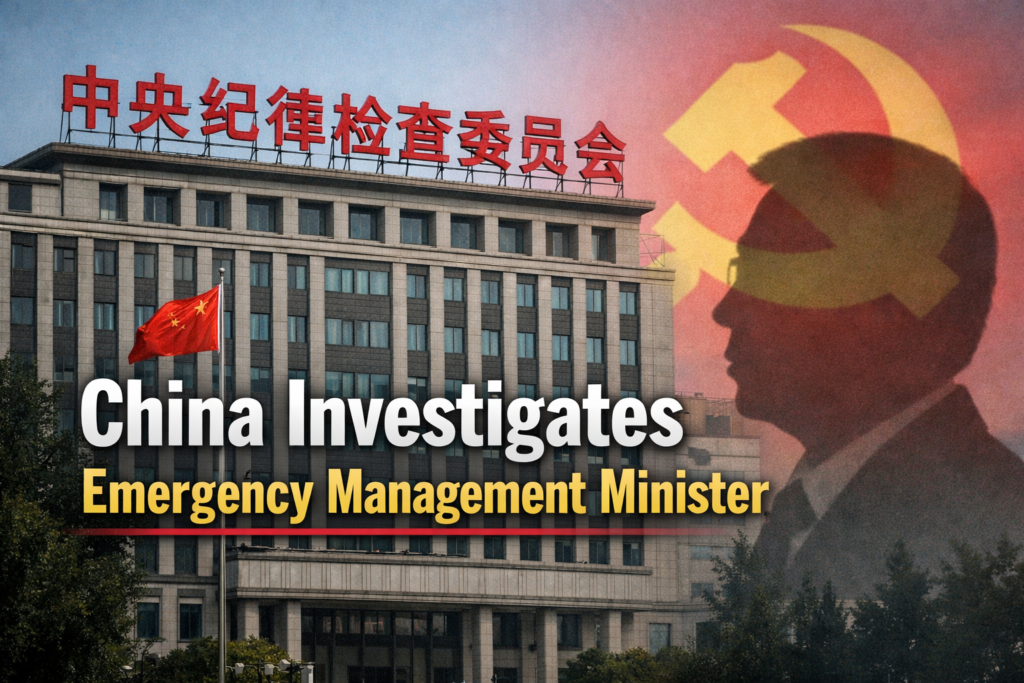
BEIJING — China’s top anti-corruption authority has launched an extraordinary investigation into Wang Xiangxi, the country’s minister of emergency management, for suspected “serious violations of discipline and law,” a phrase Beijing commonly uses to signal graft or abuse of authority. The announcement came Saturday as part of President Xi Jinping’s intensified anti-corruption campaign, which has already ensnared powerful figures across government, military and state-owned enterprises.
The probe into Wang, 63, marks a rare instance in recent years where a sitting minister is publicly placed under investigation, highlighting the expansive reach of Beijing’s anti-graft operations and the political stakes it carries both domestically and internationally.
Who Is Wang Xiangxi and Why This Matters
Wang Xiangxi assumed the role of Minister of Emergency Management in July 2022 after a long career in state leadership and corporate governance, including serving as chairman of the state-owned National Energy Investment Corporation — one of China’s largest energy conglomerates.
His ministry is responsible for managing natural disasters, workplace safety, fire control and emergency responses across the world’s most populous nation. That places Wang at the center of critical public safety structures, making this investigation especially notable.
Typically, anti-graft campaigns focus on retired officials, provincial leaders or mid-ranking cadres. A probe into a current cabinet-level official like Wang is comparatively rare and highlights how far President Xi’s anti-corruption efforts have extended deep into China’s institutional hierarchy.
What ‘Serious Violations of Discipline and Law’ Implies
In Chinese political jargon, the phrase “serious violations of discipline and law” almost always refers to allegations of corruption, bribery, or misuse of office — ranging from improper financial dealings to favoritism and breach of party rules.
However, authorities often do not disclose specifics at the outset. The official statements from the Central Commission for Discipline Inspection (CCDI) and the National Supervisory Commission have thus far offered only the broad charge, without details on the exact nature or scope of the alleged misconduct.
Beijing’s lack of transparency in such cases often fuels both speculation and political analysis, making foreign observers and analysts wonder whether such investigations are driven purely by anti-corruption motives or also by internal party struggles and power dynamics.
Context: Xi Jinping’s Broad Anti-Corruption Campaign
Xi Jinping’s ongoing crackdown on corruption began more than a decade ago and has become one of the hallmarks of his leadership. The campaign initially prioritized rooting out corrupt practices among low-ranking officials, but it has steadily climbed the hierarchy to target senior military commanders, state enterprise executives and party elites.
Last week, Beijing confirmed that Zhang Youxia, one of China’s highest-ranking military officials and a vice chairman of the powerful Central Military Commission, was also under investigation for “suspected violations of discipline and law.” That development marked one of the most dramatic escalations of the campaign within the People’s Liberation Army.
President Xi has repeatedly described the anti-graft drive as a “battle China must not lose,” underscoring the political importance placed on maintaining party discipline and rooting out corruption at all levels.
Reactions Within China’s Political Establishment
Within Chinese political circles, anti-corruption drives are often framed as necessary for strengthening governance, improving public trust, and ensuring economic stability. Official state outlets typically highlight the importance of holding officials accountable regardless of rank.
However, analysts note that the CCDI’s methods and targets can also reflect broader party priorities, including solidifying loyalty to Xi’s leadership and eliminating potential rivals or factions within the Chinese Communist Party (CCP). A probe as high-profile as Wang’s sends a strong signal to other officials that no one is above scrutiny — a message that resonates throughout China’s political landscape.
Implications for China’s Emergency Management and Broader Governance
Wang’s role overseeing emergency management makes his investigation particularly impactful. In recent years, China has faced a range of natural and industrial crises — from earthquakes to factory accidents — that require robust coordination and rapid response. While there is no suggestion that Wang’s alleged misconduct relates directly to emergency failures, the optics of a corruption probe at the head of this ministry raise questions about governance transparency and public accountability.
Corruption cases involving ministers can erode public confidence, especially when leadership roles involve critical public safety functions. How Beijing manages both the investigation and the transition within the ministry will be watched closely by domestic audiences and international observers alike.
What Happens Next? Legal Pathways and Political Signals
In China’s political system, investigations by the CCDI usually precede formal legal action. If evidence of wrongdoing is found, the official may face removal from office, expulsion from the Communist Party, prosecution, and possible imprisonment. All such actions are conducted within China’s judicial framework — a process that critics argue lacks independence from political influence.
The absence of immediate details about the allegations against Wang makes it difficult to predict his legal outcome. However, the rarity of targeting a current minister suggests that Beijing is prepared to pursue high-level accountability, even if it involves politically sensitive positions.
Broader International and Geopolitical Context
China’s anti-corruption efforts carry implications beyond domestic politics. International investors, foreign governments, and global markets watch such developments for indicators of political stability and governance risks. Allegations of corruption at high levels can affect confidence in China’s business environment, regulatory predictability, and bilateral diplomatic relations.
As China continues to assert itself on the world stage — economically, militarily and technologically — internal governance battles and high-profile corruption probes shed light on how President Xi balances authority, political loyalty, and the rule of law in an authoritarian context.