Buddhist Monks Complete 15-Week Peace Walk to Washington, D.C. — A Journey That United America in Quiet Hope
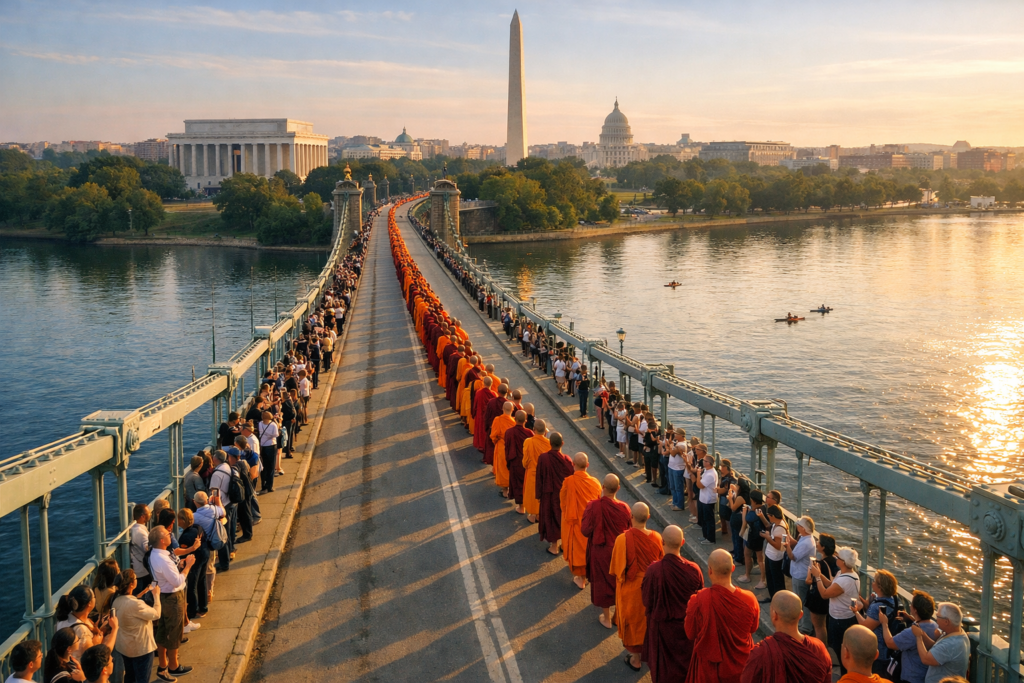
WASHINGTON, D.C. — With the winter sun casting long shadows across the Potomac River, a group of Buddhist monks in saffron and maroon robes reached the nation’s capital on Tuesday, concluding what has quickly become one of the most heartfelt and unifying journeys of the year. After 15 weeks and roughly 2,300 miles on foot, the monks completed their “Walk for Peace” — a pilgrimage from Fort Worth, Texas, to Washington, D.C. aimed at spreading mindfulness, compassion, and love in a time of division and conflict in America.
As they crossed the Chain Bridge into Washington early Tuesday morning, thousands waited along the sidewalks — some braving the chill — to greet them with quiet smiles, applause, and profound respect. The monks’ trek wasn’t about politics or protest. It was a simple, heartfelt message of peace, and in a nation grappling with internal struggles and global tensions, it resonated deeply with people from all walks of life.
Journey of a Lifetime
What began on October 26, 2025, as a small group of 19 monks setting out from the Huong Dao Vipassana Bhavana Center in Fort Worth quickly grew into a journey that captured the attention of Americans across the country. Walking mostly alone and single-file, the monks averaged about 20 miles a day, often walking barefoot or in socks — fully present with each step they took.
Their route took them through parts of eight states, winding through small towns, big cities, churchyards, city halls and open fields. Everywhere they went, people flocked to catch a glimpse of them — not to protest or make noise, but to simply stand, watch, and offer moments of silence or prayer. Many credit the monks’ calm presence and quiet demonstration as a soothing contrast to everyday stress and political polarization.
Alongside them throughout most of the trek was Aloka, a rescue dog whose name means “divine light” in Sanskrit. Aloka became a familiar symbol of gentle companionship on a long and unhurried road.
A Message Beyond Words
The leader of the group, Venerable Bhikkhu Pannakara, explained the purpose of the walk shortly after their arrival at the Washington National Cathedral, where a large interfaith assembly greeted them. “This walk isn’t about making headlines; it’s about touching hearts,” he said softly before a crowd of thousands. “When peace is cultivated within, it naturally finds its way out into our communities.”
Bishop Mariann Budde of the Washington Episcopal Diocese, who helped organize an interfaith reception for the monks, echoed that sentiment: “Their quiet dedication reminds us that compassion and inner peace are things we must choose every day, in every action.”
At several points during the walk, the monks stopped at local churches and community centers, offering lessons in Vipassana meditation — a practice that centers on breath, body awareness, and a mindful connection to the present moment. For many Americans, those shared moments in small towns or university arenas became emotional experiences — a pause to breathe deeply amid life’s noise.
Moments of Challenge and Resilience
The trek was not without hardships. In one incident outside Houston, a vehicle struck an escort vehicle that was accompanying the monks, injuring some members of the group. One monk, Phra Ajarnh Maha Dam Phommasan, suffered significant injuries that later led to the amputation of his leg. Yet, instead of retreating, the community of monks showed resilience and acceptance, continuing to walk and spread their message.
While many walked barefoot to cultivate presence and connection with the earth, others wore boots against freezing winter conditions. Each step, each breath, and each sunrise reflected a blend of spiritual patience and physical perseverance.
Crowds, Compassion and Unity
As the Walk for Peace journey made its way north, it unexpectedly became a social and cultural event. From Alabama to Virginia, townspeople lined streets in respectful silence, cheered quietly, or simply bowed their heads as the monks passed. At one point, nearly 3,500 people packed an arena at American University for a communal gathering, silently standing as the monks filed in and offering silent applause and mindful presence.
This resonance wasn’t limited to Americans alone. Millions of people worldwide tuned in online to watch livestreams and shared posts, while social media posts tagged #WalkForPeace and #Sadhu began trending among communities focused on mindfulness, healing, and compassion.
One retired engineer from Michigan drove more than 550 miles to witness the monks’ arrival in person. “In these divisive times, seeing something so calm and sincere just brings hope,” he told local news. “It’s not loud or flashy — it’s real.”
Peace in a Busy World
Though the monks plan to spend only two days in Washington, their presence left a lasting imprint. On Tuesday, they gathered at the Washington National Cathedral, where clergy and interfaith leaders spoke of compassion and kindness. They completed the walk with a ceremony scheduled at the Lincoln Memorial, a place that has long symbolized unity in American history.
One of the most poignant elements of the walk was its emphasis on ordinary actions — ones that each person can choose in daily life. Vipassana meditation, caring for others, slowing down to breathe, and offering kindness to neighbors, colleagues, and strangers became central lessons not just for the monks but for those watching their journey unfold.
Their return journey is expected to be less demanding. After an appearance at Maryland’s Capitol, the monks will ride a bus back to Texas and complete the final miles of their trek by foot — a symbolic return to where this spiritual odyssey began.
A Quiet Hope for America
In a moment when many Americans feel divided, tired, or overwhelmed, the monks’ peace walk offered something rare and simple: a reminder that unity starts within. Standing shoulder to shoulder with local families, explorers, students, and strangers who all came to witness their arrival, it was clear that something subtle yet powerful had taken shape — faith in peace as a shared human language.
This walk was not about religion, politics, or public acclaim. It was about inner peace shared outward, step by steady step. Fifty-four days may have passed since the walk began, but the impact — a quiet hope in troubled times — may linger far longer.