Australia’s Prime Minister Apologizes After Bondi Beach Attack — National Mourning and Calls for Unity
SYDNEY, AUSTRALIA — Australia observed a national day of mourning this week following the deadliest mass shooting in the nation’s modern history — a terrorist attack at Bondi Beach that killed 15 people during a Hanukkah celebration and wounded many more. As families grieved and the nation reflected on loss, Prime Minister Anthony Albanese delivered a deeply emotional apology, saying he was “profoundly and deeply sorry” that the government could not protect the victims of this attack, and urged the country to stand together against hate and violence.
The Bondi Beach massacre in December 2025 — which targeted Jewish Australians gathered for a holiday festival — shocked citizens and leaders alike, raising urgent questions about antisemitism, terrorism, public safety, and government responsibility.
A Somber National Day of Mourning
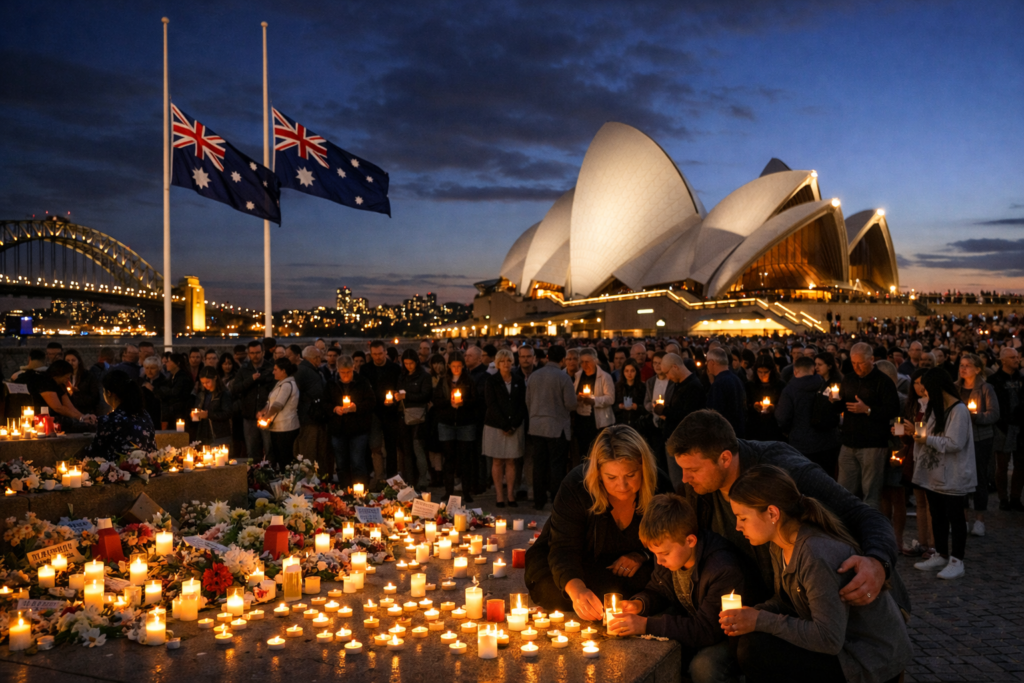
On January 22, tens of thousands of Australians marked a solemn day of remembrance across the country. At Sydney’s Opera House, a major memorial service brought together families of the victims, survivors, political leaders, and ordinary citizens in a powerful tribute to those killed and injured.
The service, themed “Light Will Win,” featured candle-lighting ceremonies, prayers, and moments of silence. Speakers included first responders, community leaders, and the surviving victims of the attack. White light projections illuminated iconic landmarks such as the Sydney Tower and Bondi Pavilion in recognition of the 15 lives lost.
Prime Minister Albanese addressed the crowd with emotion, acknowledging the pain and devastation that the attack had brought to families and to Australia’s Jewish community. “This was not just an attack on individuals — it was an attack on who we are as a nation,” he said, reinforcing Australia’s social values of inclusion and respect.
The Bondi Beach Attack
On Dec. 14, 2025, two gunmen opened fire during the Chanukah by the Sea event at Bondi Beach Park — a popular holiday celebration that drew more than 1,000 people. Police and witnesses described the event as a terrorist attack motivated by antisemitism.
The perpetrators, father and son Sajid and Naveed Akram, allegedly carried out the assault with multiple firearms and improvised explosive devices. Although explosives failed to detonate, 15 people were killed and dozens wounded. Sajid Akram was shot dead by police, while Naveed Akram was critically wounded and later charged with terrorism and 15 counts of murder.
Victims ranged in age from children to elders, including Holocaust survivors and community members who had gathered to celebrate their faith, highlighting the deep emotional impact on both local and global Jewish communities.
Unity, Remembrance and Resilience
Across the nation, vigils, community gatherings, and moments of silence marked the day, with religious and civic leaders urging unity and collective healing. In Melbourne, faith leaders from Jewish, Muslim, and Christian communities attended candlelight services, emphasizing solidarity and shared grief.
Ahmed al-Ahmed, a local shop owner who intervened during the attack and wrestled a gun from one of the shooters, was widely praised as a hero — his actions credited with saving lives amid the horror.
Prime Minister Albanese’s apology — delivered in front of a respectful, yet grieving audience — was unprecedented in its candor. He called the attack “a stain on our nation” and pledged that Australia would do more to protect minority communities, strengthen national security, and combat the rise of hate-fueled violence.
Political and Legislative Backdrop
In the aftermath of the attack, Australia’s Parliament passed new gun control and anti-hate speech legislation, reflecting a broader effort to curtail extremist violence and prevent future atrocities. The gun laws include stricter background checks, limits on ownership, and a government-funded buyback program — a rare expansion of firearm regulation in a country already known for tight restrictions.
The anti-hate speech measures empower authorities to take action against groups and symbols linked to extremist ideology, including organisations previously not classified as terrorist entities. This legislative push reflects a consensus among many lawmakers that the attack was not only a criminal act but also a symptom of rising societal divisions.
However, the political fallout has not been without controversy. Some critics argue the government’s response to rising antisemitism before the attack was slow or insufficient, and questions remain about how to balance public safety with free speech and civil liberties.
International Reactions
The Bondi Beach tragedy reverberated far beyond Australia’s shores. Leaders around the world condemned the assault and expressed solidarity with the victims. Israeli Ambassador Amir Maimon publicly urged Australia to enhance protections for Jewish communities, emphasizing the wider implications of antisemitic violence.
Numerous nations — including European states and Middle Eastern governments — also released statements condemning the attack as senseless and hateful, underscoring the global concern over extremist violence directed at religious and cultural minorities.
Security, Investigation and Community Safety
In addition to legislative reforms, Australia’s security agencies have launched reviews and expanded intelligence efforts in the wake of the incident, including the establishment of a royal commission into antisemitism and social cohesion. Officials say this comprehensive review will help better understand the roots of such violence and improve preventive measures without undermining democratic freedoms.
Heightened security remains a priority around public events and cultural gatherings, with law enforcement and community leaders working together to rebuild trust and ensure safer public spaces for all Australians.
Public Reflections and Healing
Across Australia, ordinary citizens have expressed deep shock and compassion, sharing personal stories of loss, resilience, and community support. Moments of silence were observed in schools, workplaces, and public gatherings, reinforcing a collective commitment to remember the victims and support survivors.
One teacher remarked that while the nation has been shaken, the compassion and bravery displayed in helping strangers “shows the best of the Australian spirit.”
Families of victims and survivors are being supported with counseling services and public outreach, as many grapple with the long-term impact of such a horrific event. Community organizations have doubled down on their efforts to foster inclusive dialogue, promote understanding, and condemn hatred in all its forms.
Moving Forward
As Australia navigates this painful chapter, the government, civil society, and religious communities are striving to transform grief into meaningful action — from legislative reform to community unity efforts. Prime Minister Albanese’s acknowledgment of national shortcomings reflects a broader reckoning with the challenges of protecting diverse societies in an increasingly polarized world.
In the words of many at the national memorial: while light may have dimmed on that fateful day at Bondi Beach, the collective resolve to uphold peace, inclusivity, and compassion grows stronger.