Americans Furious and Wary as Trump-Backed Election Bill Faces Fierce Pushback in the U.S. Senate
WASHINGTON, D.C. — The nation’s heart is beating a little faster — not because of hope or optimism, but because of rising tension over the future of American democracy. In the U.S. Capitol, Republican lawmakers in **the House of Representatives recently passed a controversial election overhaul bill supported by former President Donald Trump — a bill designed to tighten voting requirements before the November 2026 midterm elections. But now, that measure is running into significant resistance in the U.S. Senate, raising sharp questions about voting rights, election integrity and the very soul of U.S. elections.
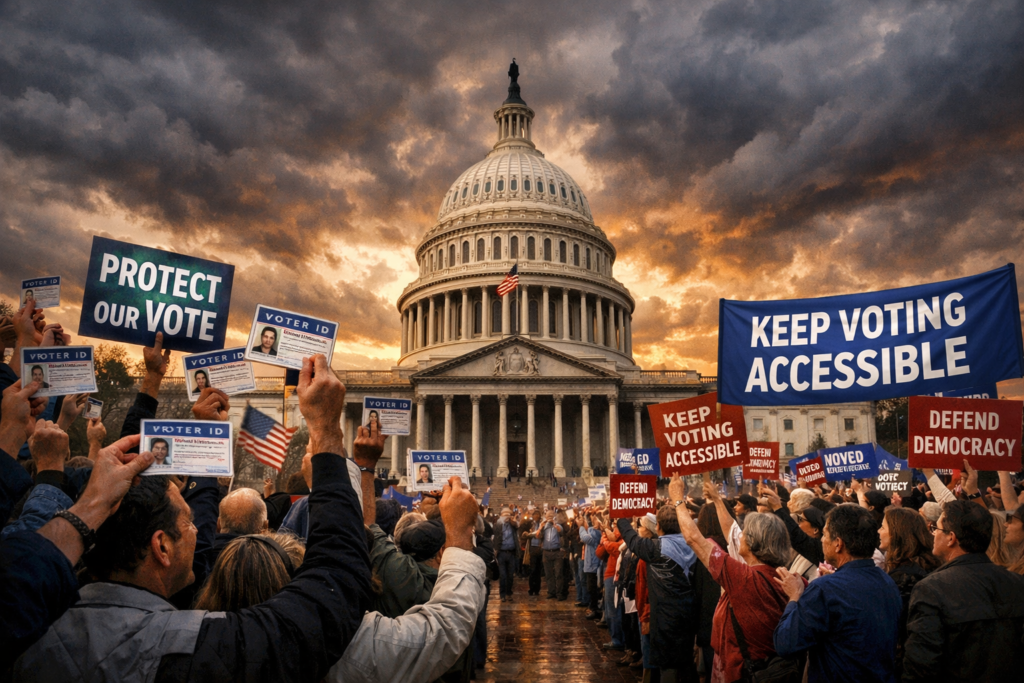
Billed by its supporters as a way to restore confidence in U.S. elections, the bill — known as the Safeguard American Voter Eligibility (SAVE) America Act — would require Americans to prove their U.S. citizenship when registering to vote and present a photo ID before casting a ballot in federal elections. But this proposal, while celebrated by some as a return to “election integrity,” has drawn fierce pushback from Democrats, civil rights activists, election officials and even a handful of Republicans wary of federal overreach and practical realities at the state and local level.
What the SAVE America Act Would Do
The SAVE America Act is the latest effort by Republicans to craft federal voting rules that apply across all 50 states — a sharp break from a long-standing tradition in which states, not the federal government, run elections. Under the bill’s provisions:
- Voters would need documentary proof of U.S. citizenship (such as a passport or birth certificate) to register for federal elections.
- All voters would be required to present a valid photo ID before casting ballots.
- States would be required to share voter data with federal agencies, potentially giving the Department of Homeland Security new visibility into voter rolls.
Supporters say these measures ensure that only eligible citizens are participating in federal elections — language that resonates strongly with Trump’s base and with Americans concerned about past election controversies. Opponents argue that such requirements could disenfranchise millions of eligible voters, especially those who lack ready access to passports or birth certificates, and that they could overwhelm local election offices with new administrative burdens months before critical primaries and midterms.
Senate Resistance and Political Clash
After narrowly passing the Republican-controlled House by a 218–213 vote, with only one Democrat joining Republicans, the bill is now in the Republican-led Senate — where its future remains uncertain.
Even within Republicans’ own ranks, resistance is emerging. Senate Majority Leader John Thune has already signaled that there may not be enough support to eliminate the Senate’s filibuster rules, which require 60 votes to advance most legislation. Without dismantling or weakening that 60-vote threshold, the bill is unlikely to move forward — even with full Republican support.
On the other side of the aisle, Democrats have pledged to use every tool available to block the bill, arguing that it amounts to federal overreach and a threat to cherished voting rights. Some Democrats have gone further, likening the bill’s requirements to past eras of voter suppression — a flashpoint that Democrats say hearkens back to Jim Crow laws used to disenfranchise African Americans in the early 20th century.
In response, Senate Republicans sponsoring the bill defend their position forcefully. Utah Sen. Mike Lee, one of the bill’s architects in the Senate, dismissed critics’ comparisons to racist laws as “paranoid fantasy,” telling reporters that requiring documentation to vote is no different from many common-sense procedures Americans follow in daily life.
A Bill That Touches Every American
What’s remarkable — and emotional — about this debate is not just the politics, but what it means to everyday Americans.
In rural towns and big cities alike, voters are speaking out. Many older Americans vividly remember voting without needing so much paperwork, and fear that strict requirements now could keep their grandchildren from participating. Others who have been too young to vote in past elections are worried their voices could be stifled by new bureaucratic hurdles. And in immigrant communities — even among families fully documented and with deep pride in their American citizenship — there’s concern that confusion and red tape at polling places could block eligible citizens from casting their ballots on Election Day.
Several secretaries of state and local election officials have also weighed in, warning that forcing all states to adopt new ID rules and federal databases before 2026 voting deadlines could create chaos at the polls, undermine voter confidence, or result in long lines and lost votes.
The Broader National Debate
The fight over the SAVE America Act isn’t happening in isolation. It comes at a time when the broader American electorate is deeply divided over questions of faith in elections — trust eroded in part by Trump’s own repeated false claims that the 2020 election was “stolen,” a narrative still echoed by many of his supporters.
Trump and his allies argue that without federal standards for voter ID and citizenship verification, the system will remain vulnerable to fraud — a claim that Republican leaders repeat with emotional conviction at rallies and in political messaging. Critics, however, say that voter fraud is extremely rare and that the bill is more about political advantage than protecting election integrity.
What’s at stake isn’t just a policy fight — it’s a national conversation about what it means to be an American voter, how accessible democracy should be, and where the line should be drawn between securing elections and preserving the fundamental right to vote for all citizens.