FBI Raid in Georgia Highlights How Trump’s 2020 Election Obsession Still Shapes Politics
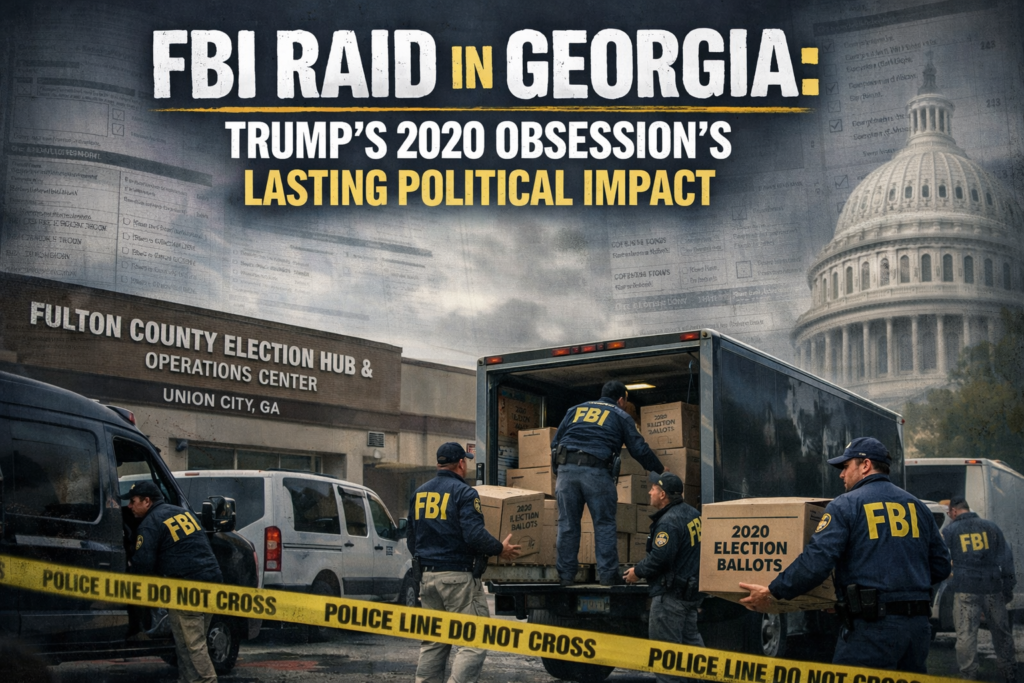
ATLANTA, Georgia — The Federal Bureau of Investigation’s aggressive search warrant executed last week at the Fulton County Election Hub and Operations Center has reignited long-smoldering political debates about the 2020 U.S. presidential election — debates driven, in large part, by former President Donald Trump’s persistent claims that the election was “stolen.” Five years after Joe Biden narrowly defeated Trump in Georgia, Trump’s 2020 election obsession continues to shape both federal action and local politics in the state that helped decide the presidency.
Federal agents entered the Union City election warehouse with a court-authorized warrant seeking ballots, tabulator tapes, ballot images, voter rolls and other 2020 election materials. Officials said the records could contain evidence of potential criminal violations of federal election law — but the move has drawn sharp criticism from Georgia Democrats, local officials, election experts and civil liberties advocates who question both the legal basis and political motives of the raid.
What the FBI Searched For and Why It Matters
On Jan. 28, 2026, FBI agents carried out a rare search at one of Georgia’s most sensitive election offices, seizing boxes of documents that date back to the contentious 2020 presidential race. The warrant, authorized by a federal magistrate judge, specifically targeted physical ballots, ballot images, machine tapes and voter registration files — materials normally archived, not actively probed years after an election.
The focus on Fulton County — the state’s most populous jurisdiction and a Democratic stronghold — is no accident. Trump has repeatedly cited Georgia and particularly Fulton as the epicenter of his allegations that widespread fraud cost him the state’s electoral votes in 2020. Those claims have been thoroughly debunked by audits, multiple recounts and court rulings, and even Trump’s own attorney general at the time acknowledged there was no evidence of fraud that would have changed the outcome.
Still, the search warrant and seizure of ballots have put Georgia back in the national spotlight, underscoring that the 2020 election — though long certified and litigated — remains politically charged as the nation heads into the 2026 midterm elections.
Trump’s 2020 Narrative and Federal Action
Critics argue the FBI’s actions reflect more than an ordinary law enforcement investigation — they are part of a broader pattern tied to Trump’s unwavering insistence that the 2020 election was fraudulent. Trump himself has publicly supported the investigation, saying the FBI and intelligence officials are acting to “keep the election safe” and promising that “interesting things will be happening” in the investigation.
Trump’s rhetoric — amplified during a speech at the World Economic Forum in Davos earlier this month — renewed speculation about possible legal consequences for individuals involved in 2020 vote counts, with Trump suggesting prosecutions could be forthcoming. But many legal experts describe this as a continuation of Trump’s long-running campaign to relitigate the 2020 results, despite repeated debunking by courts, election officials, and bipartisan audits nationwide.
Local Officials Push Back Hard
Democrats and election officials in Georgia were blunt in their criticism. Fulton County Commissioner Mo Ivory called the raid a “distraction” aimed at undermining public confidence in elections rather than serving a legitimate law enforcement purpose. Some local leaders stressed that the county’s election infrastructure has already been subject to years of audits and scrutiny, and that the materials targeted by the FBI were already under legal review.
Georgia elections have been repeatedly validated by multiple recounts and audits, yet Trump’s allies continued to push for more investigation. That political pressure fuels distrust in the electoral process, according to some critics. They say using federal power to revisit settled elections may damage public trust and could have a chilling effect on election workers and voters alike.
Unusual Involvement: Tulsi Gabbard at the Raid
Another controversial dimension of the operation was the presence of Director of National Intelligence Tulsi Gabbard at the Fulton County site. Her attendance drew bipartisan questions about whether intelligence officials were overstepping their traditional roles, since domestic election administration typically falls outside the scope of intelligence duties.
Georgia Sen. Jon Ossoff and Virginia Sen. Mark Warner criticized Gabbard’s involvement, arguing that her presence at an election raid was “highly unusual” and warranted congressional oversight. They stressed that the integrity of federal institutions depends on maintaining clear boundaries between intelligence and domestic law enforcement.
Political Ripples in a Swing State
The political fallout from the raid is reverberating beyond Georgia’s election offices. Former Atlanta Mayor and Democratic gubernatorial candidate Keisha Lance Bottoms spoke out, calling the focus on 2020 “troubling for our democracy” and arguing that obsession with past elections distracts from issues that voters care about today, such as jobs, infrastructure and public safety.
While most voters in public polls have shown decreasing concern about the 2020 race, the federal government’s visible actions — including a rare execution of a search warrant related to a historic election — have reenergized discussions about election integrity, partisanship and the role federal agencies should play in state election administration.
Legal and Historical Context
Georgia’s 2020 election was not only central to Biden’s presidential victory but also pivotal in securing Democratic control of the U.S. Senate, with two Senate runoff victories shortly after the general election. The aftermath drew intense scrutiny, legal battles, and conspiracy theories, including pressure from Trump to “find” enough votes to overturn the result — an episode immortalized by a now-infamous phone call to Georgia Secretary of State Brad Raffensperger.
Federal investigations into 2020 have spanned multiple avenues — from the Justice Department’s prosecution of the January 6 Capitol attack participants and obstruction cases to civil lawsuits and now criminal investigations tied to record preservation and alleged violations of federal law. Despite these efforts, courts have repeatedly upheld the legitimacy of the 2020 results.
What Comes Next
As the Georgia investigation progresses, the broader implications are profound. Legal experts warn that using federal resources to revisit a settled election risks further eroding public confidence in American democracy. Questions now swirl around potential misuse of federal agencies for political purposes and how these actions might influence public perception ahead of the 2026 midterms.
Republicans defending the operation argue that law enforcement must respond to credible leads and that transparency and accountability are essential. But opponents counter that the 2020 claims have been debunked and that continuing to pursue them may do more harm than good, politically and legally.
What’s clear is that Trump’s 2020 election obsession remains a defining feature of U.S. politics in 2026, shaping actions from the federal government to local offices in Georgia — and prompting fierce debates about truth, power, and the future of elections in America.