NASA’s Artemis II: First Crewed Moon Mission in Over 50 Years — What Americans Need to Know
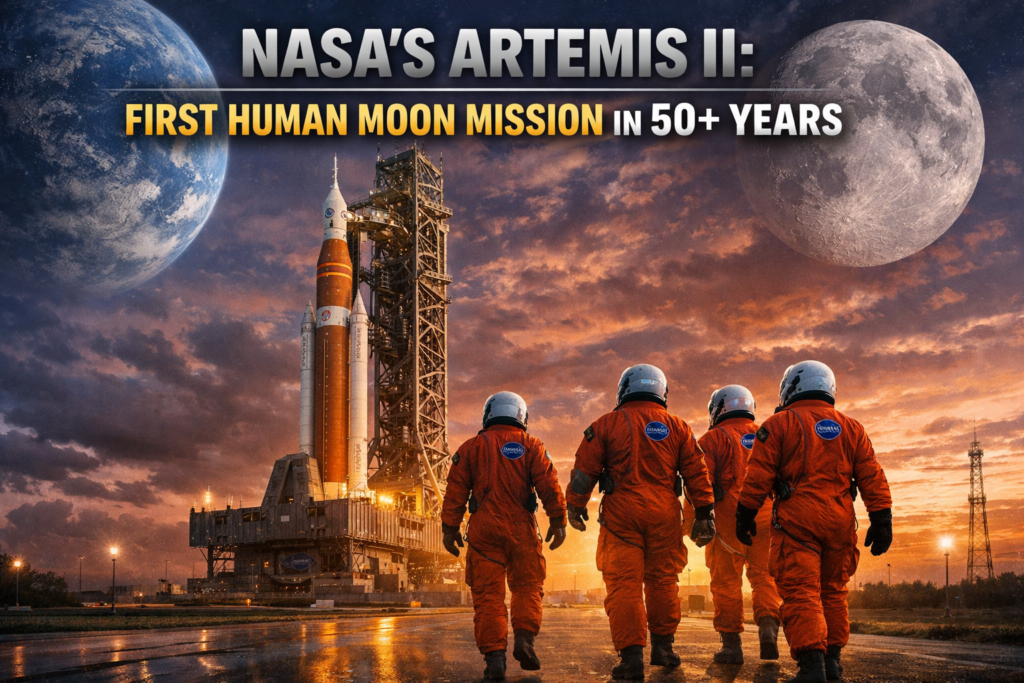
WASHINGTON, D.C. — NASA’s Artemis II mission is poised to mark a historic return of humans to the Moon’s vicinity after more than half a century — carrying four astronauts on a 10-day lunar flyby that will blaze a trail for future landings and deep-space exploration. The mission, currently scheduled to launch no earlier than February 8, 2026, is the first crewed flight in NASA’s ambitious Artemis program, reviving American leadership in lunar exploration.
Slated to launch aboard the powerful Space Launch System (SLS) rocket and the Orion spacecraft, Artemis II isn’t intended to land on the lunar surface. Instead, it will take its crew around the Moon and back in a free-return trajectory — an approach that sends the spacecraft beyond lunar orbit and then safely back to Earth using the Moon’s gravity. This mission represents NASA’s first human spaceflight beyond low-Earth orbit since Apollo 17 in 1972.
The Mission and Its Goals: Testing Deep Space Readiness
Artemis II serves as a critical test flight under NASA’s long-term lunar exploration roadmap. Its objectives go far beyond mere symbolism: astronauts will evaluate Orion’s life-support, communication, propulsion, and safety systems under deep-space conditions, proving that the spacecraft and crew can operate effectively far from Earth’s protective magnetosphere.
This mission also furthers NASA’s efforts to establish a sustainable human presence on and around the Moon, a key stepping stone toward even more ambitious goals — including eventual crewed missions to Mars. Artemis II will help iron out procedures and systems ahead of Artemis III, which aims to land the first woman and next man on the lunar surface.
Unlike Apollo’s direct approach to lunar orbit, Artemis II will trace a “free-return” pathway, which means Orion’s trajectory will swing around the Moon and then rely on lunar gravity to loop back toward Earth. This profile safeguards the crew by keeping the spacecraft on a path that naturally returns home in case of anomalies.
Meet the Crew: A Diverse Team of Pioneers
NASA has selected a four-astronaut crew for this historic mission — a blend of experience, skill, and diversity that reflects the evolving face of human space exploration:
- Reid Wiseman (Commander) — A seasoned Navy pilot and former NASA chief astronaut, Wiseman brings extensive spaceflight experience and leadership as he guides the crew beyond Earth’s orbit.
- Victor Glover (Pilot) — A U.S. Navy test pilot and veteran of long-duration spaceflight, Glover will manage key spacecraft operations aboard Orion.
- Christina Koch (Mission Specialist) — A longtime NASA astronaut with record-setting missions aboard the ISS, Koch will support technical and scientific activities during the flight.
- Jeremy Hansen (Mission Specialist, Canadian Space Agency) — A Canadian astronaut and fighter pilot, Hansen will be the first non-American to travel around the Moon, symbolizing international collaboration on lunar exploration.
Together, these four explorers will embark on a journey that will take them more than 230,000 miles from Earth, testing not only spacecraft hardware but also human endurance and spaceflight procedures in deep space.
Preparation and Countdown: Quarantine and Weather Delays
In late January 2026, the Artemis II crew entered pre-launch quarantine at NASA’s Johnson Space Center in Houston — a standard procedure designed to ensure astronaut health before departure, as any illness could jeopardize mission safety.
However, the launch sequence has faced challenges, including a delay of the wet dress rehearsal — a full rocket fueling and countdown test — due to unusually cold weather at Cape Canaveral. This postponement has shifted NASA’s earliest possible launch window to around Feb. 8, 2026, with several potential days available in February before scheduling moves into March.
The agency has teams strategically working to adapt to Florida’s cold conditions while keeping Orion and the SLS rocket within safe operating parameters, because protecting critical systems and crew health remains NASA’s highest priority.
Why Artemis II Matters
Artemis II stands as a symbol of American innovation and scientific ambition. It demonstrates the nation’s resolve to reclaim lunar exploration leadership and to push the boundaries of human spaceflight further than in decades. This mission will reassure engineers, scientists, and the public that NASA’s deep-space systems are ready for extended crewed missions, paving the way for sustained exploration and utilization of the Moon.
Unlike previous Apollo missions, Artemis reflects a global and cooperative vision of space exploration. The inclusion of a Canadian astronaut and contributions from international partners underscores that humanity’s return to the Moon is not solely an American endeavor but a collaborative pursuit of scientific discovery.
From testing onboard systems to validating deep-space navigation and communications, Artemis II will offer invaluable data and confidence as NASA builds toward future departures — including Artemis III’s lunar landing and eventual human missions to Mars.
What Happens After the Flight
Once the Artemis II mission is complete, Orion’s reentry and splashdown in the Pacific Ocean will conclude about 10 days of spaceflight and bring the crew home safely, laying the foundation for more advanced missions ahead.
The success of Artemis II will allow NASA to validate procedures and technologies that are essential for longer stays on and around the lunar surface. Artemis III and subsequent missions will build on this foundation, advancing human habitation of deep space while inspiring new generations of scientists, engineers, and explorers.