Panama Supreme Court Rules Hong Kong Firm’s Panama Canal Port Concession Unconstitutional
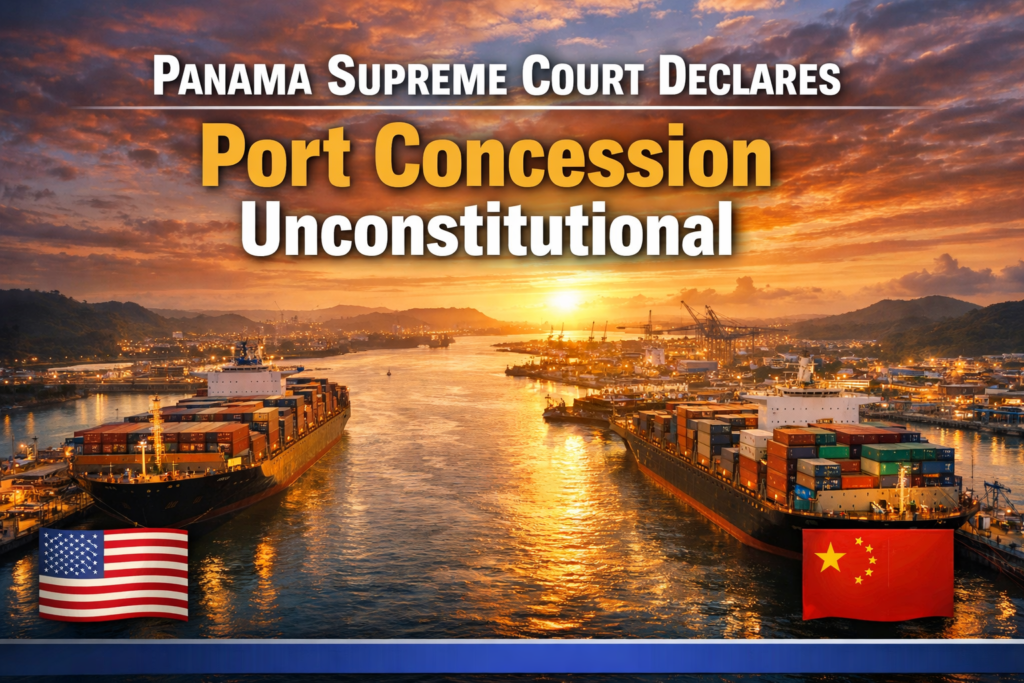
PANAMA CITY — In a sweeping ruling with major global economic and geopolitical repercussions, Panama’s Supreme Court has declared unconstitutional the long-standing concession that allowed a Hong Kong-based company to operate key port facilities at either end of the Panama Canal, throwing one of the world’s most important shipping corridors into legal and diplomatic uncertainty.
The judgment, announced late Thursday, undercuts a contract held by the Panama Ports Company (PPC) — a subsidiary of Hong Kong’s CK Hutchison Holdings — that had governed operations at the Balboa and Cristóbal container terminals since the early 1990s. The decision stems from an audit that raised questions about irregularities in the contract’s renewal and comes amid sustained pressure from the United States to limit perceived Chinese influence over critical global trade infrastructure.
What the Ruling Says and Why It Matters
Panama’s highest court found that the laws authorizing the concession — including its 25-year extension in 2021 — violated constitutional provisions, effectively voiding CK Hutchison’s authority to manage the two major ports flanking the Panama Canal.
The audit cited by the court highlighted accounting discrepancies, missing payments, and administrative oversights, as well as the absence of required legal endorsements for the most recent contract extension. Officials estimated the irregularities may have cost Panama hundreds of millions of dollars over decades.
Perhaps most consequentially, the ruling throws into question the legal legitimacy of a $23 billion proposed sale of the Panama port operations by CK Hutchison to an international consortium including U.S. investment firm BlackRock Inc. — a deal once touted as a potential realignment of control that would appease Washington’s concerns about foreign influence.
Geopolitical Tensions Behind the Legal Battle
Though Panama asserts the ruling is a constitutional matter rooted in national law, the decision also intersects with broader U.S.-China strategic competition. Former U.S. President Donald Trump and senior American officials have long labeled Chinese involvement around the canal as a security issue, framing the region as a key front in global power dynamics.
U.S. Secretary of State Marco Rubio visited Panama to emphasize Washington’s stake in events around the canal, underscoring the political dimension of what might otherwise be seen as a purely commercial dispute.
For Panama, however, the ruling is being framed as a matter of sovereignty and adherence to constitutional law — a stance that President José Raúl Mulino’s administration insists should take precedence over foreign pressure from any global superpower.
Reactions From Hong Kong, China, and Panama
CK Hutchison rejected the ruling outright, asserting that the contract was the result of transparent, internationally competitive bidding and accusing the Panama Supreme Court of jeopardizing “the well-being and stability of thousands of Panamanian families” whose livelihoods depend on port operations.
Hong Kong’s government echoed that condemnation, calling the ruling “unreasonable” and warning that it could harm the city’s investment climate. Officials urged Hong Kong companies to reassess existing ventures in Panama and cautioned against foreign governments using legal means to alter business agreements retroactively.
China’s foreign ministry also expressed strong objections, with a spokesperson promising measures to protect the “legitimate rights and interests” of the Chinese company involved — though Beijing offered few details on what steps it might take.
Panama’s comptroller — whose office initiated the legal challenge — maintains that the court’s decision safeguards public resources and ensures that future concessions adhere to constitutional requirements.
Economic and Trade Implications
The Panama Canal is a linchpin of global commerce, handling an estimated 5 percent of all seaborne trade as vessels transit between the Atlantic and Pacific Oceans. Its two major ports — Balboa and Cristóbal — serve as strategic hubs for container shipping and logistics.
The court’s decision has rattled investors and markets, with CK Hutchison’s share price dipping amid concerns over the future of its operations and the stalled sale of its port assets.
Economic analysts warn that the ruling could complicate international shipping agreements, disrupt existing business plans around the canal, and prompt competitive tenders for the now-vacated port contracts — potentially drawing interest from American, European, and regional bidders.
What Happens Next? Legal and Operational Uncertainty
While the constitutional ruling effectively invalidates CK Hutchison’s concession, it does not immediately halt port operations. The Panamanian government and the Panama Maritime Authority are now tasked with determining interim arrangements and a path forward, which could involve new contract bids or temporary state control.
Legal experts also expect CK Hutchison to pursue domestic and international challenges, seeking arbitration or other remedies to protect its multi-billion-dollar investment.
For now, the ports continue to function, ensuring that global trade isn’t abruptly disrupted — but the business and diplomatic tussle over their future is only just beginning.
The Broader Strategic Context
This dispute underscores the enduring geopolitical contest for influence over vital global infrastructure. As nations like the United States and China vie for leverage in trade routes and logistics networks, smaller states such as Panama are increasingly caught between competing strategic interests — navigating internal legal frameworks while balancing external diplomatic pressures.
Whether this ruling signals a new era of Panama asserting autonomous control over its strategic assets or sets a precedent for similar legal challenges elsewhere, its impact will reverberate far beyond Central America’s shores.