Eleanor Holmes Norton Announces Retirement — A Pivotal Moment for D.C.’s Voice in Congress
WASHINGTON, D.C. — Eleanor Holmes Norton, the longtime non-voting delegate to the U.S. House of Representatives for the District of Columbia, has formally ended her reelection campaign and announced she will retire at the end of her current term, bringing to a close a remarkable 35-year career in Congress. Norton’s decision marks the end of an era for the nation’s capital — a city long denied full voting representation in Congress but whose fight for equality and statehood she fiercely championed.
At 88 years old, Norton has served Washington, D.C.’s roughly 700,000 residents since she was first elected in 1990, becoming one of the most recognizable figures in the city’s modern political history. Her retirement announcement opens the door to a competitive Democratic primary in a district that reliably supports Democratic candidates — and invites fresh voices to take on the city’s unfinished business in the halls of Congress.
A Storied Career That Defined D.C. Representation
Norton’s long tenure as D.C.’s delegate was marked by dogged advocacy for issues that ordinary Americans rarely associate with a non-voting representative — including civil rights, federal worker protections and, most notably, D.C. statehood. Although delegates cannot cast final votes on the House floor, Norton became expert at leveraging committee influence, media attention and bipartisan relationships to elevate the city’s concerns.
Her legacy is especially tied to the campaign for full representation: a cause she helped transform from marginal political rhetoric into a central tenet of the Democratic Party’s platform. During her time in office, the House passed legislation to make the District the 51st state, including a bill in 2021 that passed the House but stalled in the Senate amid Republican opposition.
Even amid the limitations of her non-voting role, Norton was known for securing bipartisan wins that benefited District residents, including legislation aimed at expanding educational opportunities and addressing local economic challenges.
Retirement Announcement and Reaction
Norton’s retirement announcement, confirmed in filings with the Federal Election Commission (FEC) on January 25, formally closes her reelection campaign and signals that she will not seek another term in the November 2026 elections. In her statement, she expressed deep gratitude to the people of Washington, D.C. and said it was time to “lift up the next generation of leaders.”
D.C. Mayor Muriel Bowser praised Norton as a “Warrior on the Hill,” noting her unwavering advocacy for the city’s rights and influence in federal policy. Mayor Bowser’s public remarks reflected widespread local respect for Norton’s decades of service, even as questions about generational transition and evolving leadership dynamics were under discussion.
A Legacy of Advocacy and Unfinished Business
Throughout her three-plus decades in Congress, Norton confronted challenges few members of Congress experience. As a nonvoting member of the House, she could sponsor legislation, serve on committees and shape debate, but she could not cast a final vote on the House floor — a restriction she often described as a fundamental injustice for D.C. residents.
Under Norton’s leadership, the fight for D.C. statehood gained national visibility. Her relentless pursuit of equal representation helped push the issue into the mainstream of Democratic Party priorities, even if statehood legislation has yet to clear the U.S. Senate.
Beyond statehood, Norton’s tenure encompassed major political and social upheavals — from the crack epidemic and financial crises in the District during the early 1990s to the aftermath of the Trump administration’s federal intervention in D.C.’s local policing and civil affairs. Through it all, she remained a visible and vocal advocate for her constituents.
Health and Leadership Questions
In recent years, Norton’s age and health became topics of public and political discussion. Critics pointed to incidents — including a widely reported scam in 2025 that led to a police report describing her as having “early stages of dementia” — as raising questions about her ability to continue serving effectively. Norton and her office disputed those characterizations, emphasizing that such assessments were not qualified medical findings.
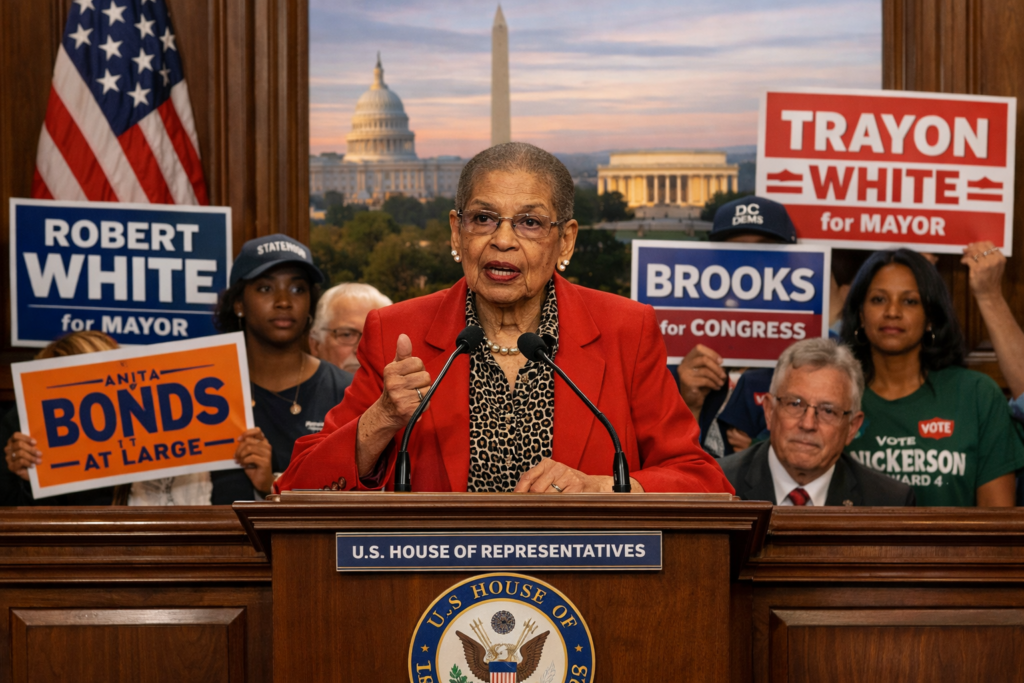
Although Norton was first elected with broad support and minimal opposition, the 2026 election cycle was shaping up differently. A competitive Democratic primary field had begun emerging, including D.C. Council members Robert White and Brooke Pinto, former Democratic National Committee official Kinney Zalesne, and Norton’s own former aide Trent Holbrook — reflecting broad interest in leading the city’s next chapter.
What Comes Next for D.C.’s Representation
Norton’s departure will mark a significant transition for Washington, D.C. — a jurisdiction that has long fought for a voice equal to that of states, despite its large population and substantial tax contributions. With the seat opening in 2026, the Democratic primary is expected to draw intense attention not only locally but nationally, as issues like voting rights, urban policy, and federal oversight remain at the forefront of political debate.
The next delegate will inherit both the legacy of Norton’s accomplishments and the persistent challenge of advancing D.C. statehood — a cause that, decades into her career, remained unfulfilled but more politically salient than ever.
Taking Stock: Norton’s Place in History
Eleanor Holmes Norton’s retirement is not just the end of a long political career — it is a moment to reflect on the evolution of Washington, D.C.’s relationship with the federal government and the continuing push for full democratic representation. Her role as one of the longest-serving Black women in congressional history and her journey from civil rights activist to respected congressional voice remain central parts of her legacy.
As the city looks ahead, many residents say Norton’s work laid the groundwork for a new generation of leadership ready to carry forward the fight for equality, autonomy and representation in the nation’s capital.