Iran-Backed Militias Threaten New Attacks as U.S. Aircraft Carrier Heads to Middle East
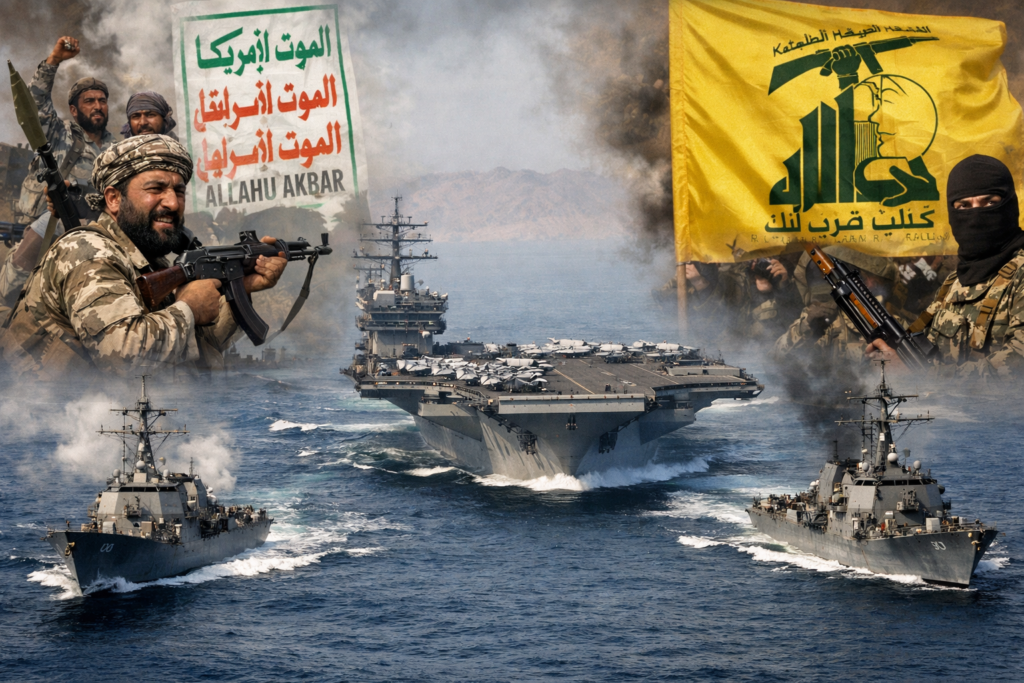
DUBAI, UNITED ARAB EMIRATES — Just as the U.S. Navy’s aircraft carrier USS Abraham Lincoln and its strike group reached the Middle East amid mounting regional tensions, Iran-backed militias in Iraq and Yemen issued ominous threats of fresh attacks, raising fears of a dangerous escalation between Washington and Iran’s network of allies and proxies. These warnings, coming from groups historically tied to Tehran’s regional ambitions, underscore how volatile the geopolitical landscape has become — driven by internal unrest in Iran, fractured alliances, and the specter of broader military confrontation.
U.S. Carrier Deployment Amid Rising Tensions
The U.S. deployed the USS Abraham Lincoln aircraft carrier along with guided-missile destroyers to the Middle East in what U.S. military officials described as a move to promote regional security and stability. The deployment follows President Donald Trump’s warning of potential military action if Iran’s government continues its harsh crackdown on nationwide protests and carries out alleged mass executions of detainees.
The arrival of the Lincoln, supported by F-15E Strike Eagles, F/A-18 fighters and advanced missile systems, has significantly bolstered U.S. firepower in the region — a clear signal that Washington is prepared for multiple contingencies even as it maintains that force is a last resort.
But rather than easing friction, the carrier’s presence has prompted defiant responses from Iran-aligned militant groups, especially in Iraq and Yemen — two countries where proxy forces have historically been leveraged by Tehran to project influence across the Middle East.
Militia Threats: Houthis and Kataib Hezbollah
On Monday, Yemen’s Iran-backed Houthi rebels hinted they could resume attacks on commercial and military vessels in the strategic Red Sea corridor. A short video circulated by the Houthis showed ships aflame, accompanied by the caption “Soon,” a stark warning that they may reinitiate a wave of naval harassment reminiscent of their extensive campaign last year.
Last year’s Houthi Red Sea offensive involved more than 100 attacks on shipping using missiles, drones and unmanned boats, targeting international seaways and global trade routes — a major disruption that drew worldwide attention and U.S. countermeasures.
Meanwhile in Iraq, the powerful Shiite militia Kataib Hezbollah — long supported by Iran’s Revolutionary Guard Corps — issued its own direct threat, warning that any conflict targeting Iran would unleash “total war” across the region. The group’s rhetoric reflects lingering discontent and a willingness by some factions to escalate violence in support of Tehran’s geopolitical interests.
Collectively, these groups are part of what Iran describes as its “Axis of Resistance” — an umbrella of allied militias committed to confronting U.S. and Israeli influence throughout the region. They have historically played key roles in proxy conflicts in Iraq, Syria and Yemen.
Iran’s Position: Threats and Preparedness
Iran’s civilian and military leadership has also weighed in — with senior officials characterizing any U.S. military action as an existential threat and promising severe retaliation. Iranian Defense Ministry spokesperson Gen. Reza Talaei-Nik warned that any attack “would be met with a response more painful and decisive than in the past,” emphasizing Tehran’s readiness and resolve.
In Tehran’s Enghelab Square, authorities unveiled a mural showing a U.S. aircraft carrier strewn with bodies, paired with the warning “If you sow the wind, you will reap the whirlwind” — a forceful piece of propaganda reflecting Iran’s defiant posture in the face of Western pressure.
Iran has also moved to tighten control over its airspace during the crisis, grounding small private flights while allowing limited exemptions for industry and emergency services — a sign of heightened concern within its military apparatus.
Regional Impact: Allies, Diplomacy and Diplomatic Frictions
The responses from Iran’s neighbors have been mixed. The United Arab Emirates (UAE), hosting much of the diplomatic engagement in the Gulf, has made clear that it will neither allow its airspace nor its waters to be used for military operations against Iran, emphasizing a preference for dialogue and diplomatic solutions over force.
Other Gulf states, mindful of the risks of broader confrontation and eager to protect energy markets and international trade routes, have likewise been cautious, balancing diplomatic pressure on Tehran with efforts to avoid a full-blown regional conflict.
Protest Crackdown and Broader Tensions
The militia threats are occurring against the backdrop of a brutal crackdown on protesters in Iran that began in late December, triggered by economic hardship and political grievances. Estimates from human rights groups suggest nearly 6,000 people have been killed and tens of thousands arrested, marking one of the deadliest episodes of unrest in decades. Iranian officials, by contrast, report significantly lower figures and label many of those detained as “terrorists.”
This domestic suppression has intensified global scrutiny of Tehran and contributed to the heightened security environment prompting the U.S. military buildup.
What Militias Could Do
Although neither the Houthis nor Kataib Hezbollah have provided specific plans or timelines for renewed attacks, the rhetoric alone has raised alarms in Washington and allied capitals.
If the Houthis resume Red Sea assaults, they could disrupt global maritime trade and threaten commercial and military vessels alike. Yemen’s strategic position adjacent to the Bab el-Mandeb — a chokepoint through which approximately 12% of global seaborne trade passes — makes maritime attacks especially consequential.
In Iraq, militias like Kataib Hezbollah have a history of targeting U.S. facilities and personnel, often through rocket barrages and drone strikes, especially when Tehran feels pressured or perceives a threat to its national security. Although direct militia action against an aircraft carrier strike group would represent a significant escalation, these groups have repeatedly shown they are willing to test U.S. defenses in proxy battles.
Strategic Implications: Escalation or Deterrence?
The U.S. presence is intended as both a deterrent and posture of readiness. National security officials say the Abraham Lincoln and its escort ships — equipped with Aegis defense systems, fighter aircraft and anti-submarine capabilities — represent a powerful signal that any attack on American forces or interests will be met with overwhelming response.
At the same time, the U.S. deployment complicates diplomacy by increasing the risk that a miscalculation by militias or Iran could trigger broader hostilities. Analysts note that while deterrence can prevent some forms of aggression, it also risks amplifying tensions when adversaries feel encircled or threatened.
Looking Ahead: Risk Management and Diplomacy
With both sides trading threats and military assets mobilizing, the coming days and weeks could shape the trajectory of Middle East stability. Diplomatic efforts aimed at de-escalation have been intermittent, with international actors urging restraint even as national leaders prepare for worst-case scenarios.
As Iran’s internal unrest continues and militia groups test the limits of U.S. resolve, the potential for renewed attacks on shipping, American forces or regional allies remains a deeply troubling factor in an already tense geopolitical environment.