Ukraine’s Foreign Minister Says Putin ‘Cynically’ Attacked During Abu Dhabi Peace Talks
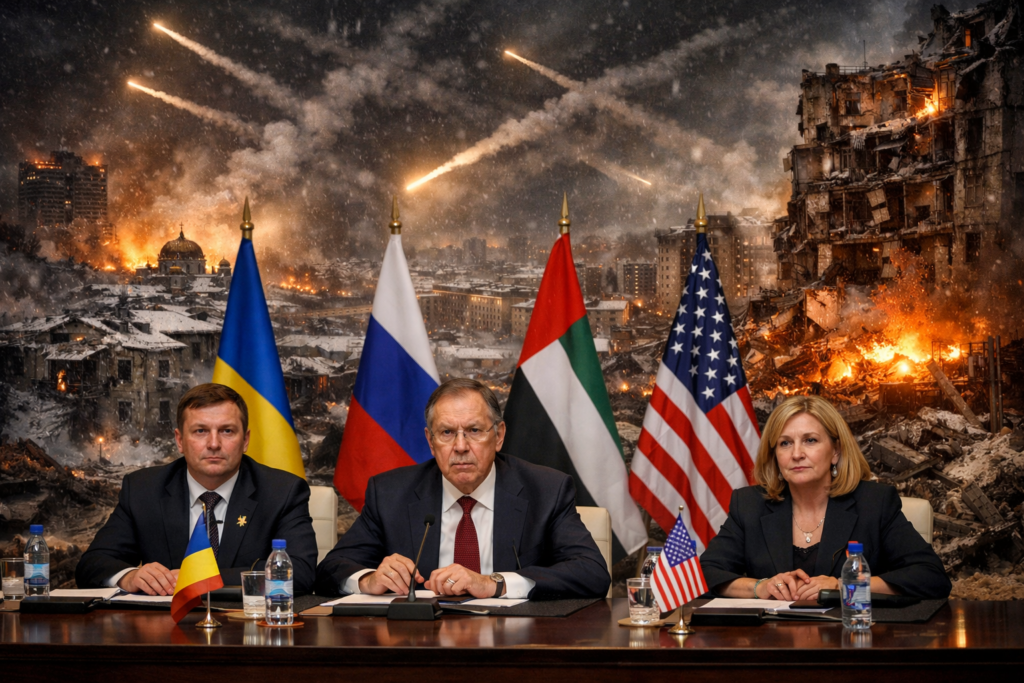
ABU DHABI, UAE / KYIV — As Ukrainian, Russian and U.S. delegations gathered in **Abu Dhabi this week for Washington‑brokered peace talks aimed at ending nearly four years of war, Ukraine’s top diplomat issued a blistering rebuke of Russian President Vladimir Putin, accusing him of undermining diplomacy with a “cynical” missile and drone assault during negotiations. The attack struck Kyiv and Kharkiv at the very moment negotiators were attempting to build momentum toward a ceasefire and settlement — a move Ukraine’s leadership says exposes Moscow’s true intentions.
“This barbaric attack once again proves that Putin’s place is not at the board of peace, but at the dock of the special tribunal,” Foreign Minister Andrii Sybiha wrote on social media platform X, sharply condemning the timing and scale of the assault.
Massive Strikes While Diplomacy Is Underway
Early on Saturday, Ukraine reported that Russian forces had launched a massive barrage — upwards of 375 attack drones and 21 missiles — on its major cities, including Kyiv and Kharkiv, killing at least one person and injuring dozens more. The Ukrainian Air Force said the strikes targeted critical energy infrastructure, knocking out power and heat for large parts of the capital in sub‑freezing temperatures just as talks were underway.
According to Ukrainian officials, the attack came as delegations from Ukraine, Russia and the United States were attending peace negotiations hosted by the United Arab Emirates, undermining efforts to forge a diplomatic path to end Russia’s full‑scale invasion.
Sybiha’s scathing statement called the assault not only an attack on civilians, but also a direct strike on the peace process itself. “His missiles hit not only our people, but also the negotiation table,” Sybiha declared — a vivid metaphor for what Kyiv sees as Russia’s insincerity.
Trilateral Talks in Abu Dhabi: Historic But Fraught
The peace talks in Abu Dhabi represent one of the few direct engagements involving all three sides since the war began in February 2022. For the first time, diplomats and negotiators from Ukraine, Russia, and the United States met at a single table in an attempt to bridge deep divides over the future of Ukraine’s territory and security guarantees.
A key sticking point in the negotiations has been Russia’s insistence that Ukraine cede control over parts of its eastern Donbas region — including roughly 20% of Donetsk Oblast that Kyiv still controls — something Ukraine refuses to accept.
Ukrainian President Volodymyr Zelenskyy had urged delegates to use the meetings to demonstrate Russia’s readiness for peace, while emphasizing that Moscow must show a commitment beyond mere negotiations. But the overnight strikes, in Ukraine’s view, struck at the heart of that premise.
Human Toll Amid Diplomatic Gambits
Beyond the political symbolism, the attacks had real human costs. At least one civilian was killed in Kyiv, and dozens more were wounded in both Kyiv and Kharkiv, according to regional authorities. The barrage also crippled large portions of the capital’s energy grid — leaving families without heat and power in severe winter weather, a recurring plight that has defined much of Ukraine’s wartime civilian experience.
Such attacks have been a grim constant throughout the conflict, but to have them coincide with a major diplomatic effort has fueled outrage in Kyiv and among Ukraine’s Western allies. Officials argue that Russia’s actions reveal that its strategy remains rooted in military coercion rather than genuine negotiation.
A War of Words and War of Missiles
From Abu Dhabi, the U.S. has sought to position the peace talks as constructive, emphasizing that dialogue remains crucial to ending a war that has killed tens of thousands and displaced millions. Washington has repeatedly urged both sides to engage in good faith, even as Moscow continues offensive operations.
But for Ukraine, the timing of the strikes speaks volumes. “Cynically launched attacks during talks — that is not the act of a partner committed to peace,” Sybiha wrote, echoing widespread frustration in Kyiv.
President Zelenskyy had acknowledged before the strikes that it was too early to draw conclusions from the first day of talks, insisting that actions would matter more than words. Russia’s continuation of military pressure has raised questions about just how ready Moscow is to end the war it started.
Territorial Disputes Still Divide Parties
Observers point out that the war’s core issues remain unresolved. Russia’s repeated insistence that Ukraine surrender contested territory — specifically parts of eastern Ukraine — continues to be a major stumbling block in negotiations. Ukraine refuses to cede areas that have not been captured by Russian forces, even as Moscow ties peace to territorial concessions.
Public opinion polls in Ukraine show overwhelming resistance to territorial concessions, reflecting deep national resolve and skepticism that diplomacy under military duress can secure lasting peace.
Abu Dhabi Talks — Symbolic but Challenging
Despite Putin’s participation through delegation representatives and the presence of U.S. mediators, the peace process is facing uphill obstacles. Critics on all sides argue that talks without simultaneous de‑escalation on the battlefield are unlikely to yield a breakthrough. The juxtaposition of high‑stakes diplomacy with deadly attacks illustrates the challenge — and the risk — inherent in negotiating while war rages.
As diplomats prepare to reconvene for the final day of discussions, the question remains: Can a negotiated end to the war coexist with a trajectory of ballistic assaults and strategic coercion? Ukraine’s foreign minister — and many civilians suffering the consequences — say last weekend’s strikes provide a stark answer unless behavior on the ground changes.