Jared Kushner’s ‘New Gaza’ Vision Clashes With Reality on the Ground
ABU DHABI & DAVOS — In a bold and optimistic presentation at the World Economic Forum in Davos, Switzerland, Jared Kushner — son-in-law of U.S. President Donald Trump and a key Middle East adviser — outlined an ambitious master plan to rebuild the war-devastated Gaza Strip as a gleaming Mediterranean hub of modern cities, luxury towers, bustling ports and industrial zones. But while Kushner’s “New Gaza” vision captured global headlines with its glitzy renderings, experts, humanitarian groups and Palestinians on the ground say the plan is strikingly out of touch with the realities facing Gaza’s devastated population.
Backed by the newly formed Board of Peace, a U.S.-led reconstruction initiative, Kushner’s proposal imagines a transformed Gaza — replete with sprawling residential districts, tourism corridors, advanced manufacturing hubs, and a state-of-the-art port — rising from the rubble left by more than two years of fierce conflict. But countless obstacles, including unresolved security concerns, political division, lack of clear funding and the immense scale of destruction, raise doubts about whether the plan can ever come close to fruition.
The “Master Plan” at Davos: Urban Utopia
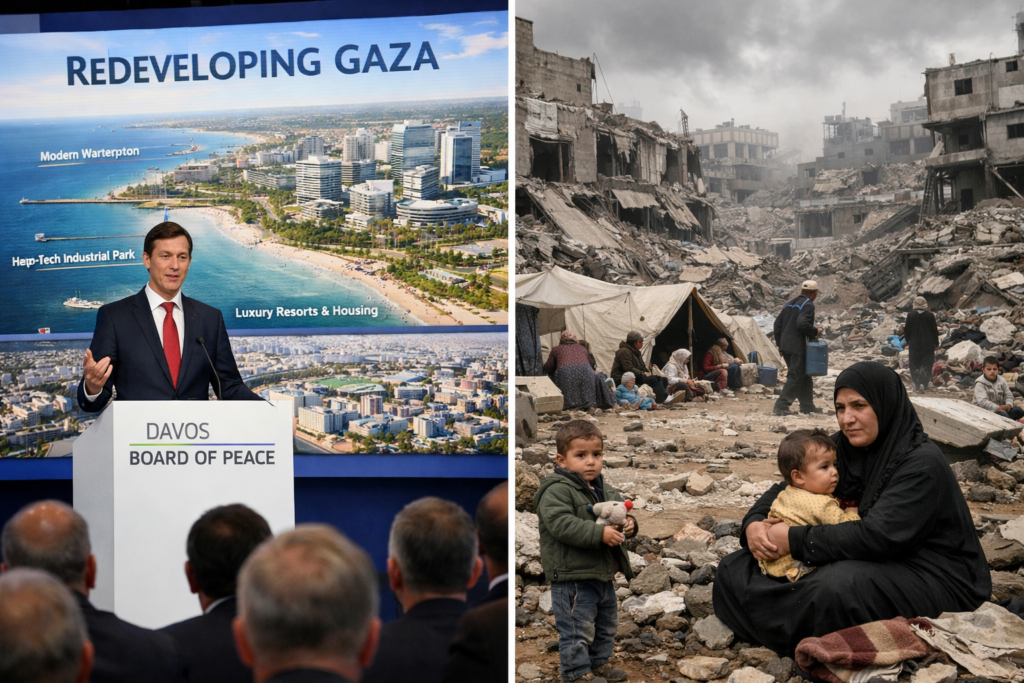
At the Davos forum on January 22, Kushner presented meticulously designed visuals showing high-rise residential blocks, resort-style boulevards, parks, and port facilities lining Gaza’s shoreline — a stark contrast to the shattered neighborhoods and infrastructure that currently define much of the coastal territory. Trump, appearing alongside Kushner at the Board of Peace launch, echoed the optimism, emphasizing the potential economic revival and inviting international investment.
Kushner claimed that the reconstruction could begin rapidly once “security is established,” suggesting that Gaza’s cities could be rebuilt in two to three years, and ultimately create an economy with full employment and modern infrastructure. The blueprint also includes plans for new roads, an airport, data centers, and facilities for advanced industries.
The plan’s outlines extend far beyond housing, proposing a coastal tourism zone with promenades and beachfront attractions and an industrial zone that could make Gaza a commercial hub in the region. Trump described the area as a “beautiful piece of property,” tapping into his real-estate sensibilities and inviting private investment.
On the Ground: Reality of Rubble and Risk
Yet the gleaming mock-ups mask a grim truth. Much of Gaza remains in ruins from the two-year war that erupted in October 2023, when hostilities between Israel and Hamas intensified into widespread urban destruction. Entire neighborhoods have been reduced to rubble, utilities lie in tatters, and unexploded ordnance — including shells and missiles — litter the terrain, making basic reconstruction efforts perilous.
The United Nations estimates that more than 60 million tons of debris must be cleared before meaningful reconstruction can begin, and that alone could take more than seven years. Additionally, widespread contamination of water supplies, disease outbreaks and the collapse of sewage systems complicate the work of restoring basic services.
Critically, Kushner did not outline a concrete strategy for where Gaza’s displaced population — currently crowded into narrow patches of habitable land — would live during reconstruction or how demining and rubble removal would be managed. Heavy machinery necessary for large-scale clearance has been slow to enter Gaza due to ongoing restrictions and unresolved security arrangements, according to humanitarian reports.
Security First — A Major “If”
A central condition of Kushner’s proposal is the complete demilitarization of Gaza, a prerequisite he insists is essential for investment and development. He suggested that armed groups in Gaza, including Hamas, would need to be disarmed or integrated into a new governance structure under a technocratic Palestinian committee known as the National Committee for the Administration of Gaza (NCAG).
This requirement — which remains politically fraught — is complicated by continuing tensions and near-daily violations of the ceasefire between Israeli forces and armed factions in Gaza. The prospect of comprehensive disarmament is uncertain at best and potentially unworkable without significant political breakthroughs.
Political experts also warn that tying reconstruction to sweeping security guarantees may delay or derail any progress, especially in areas where control remains contested. Israel has insisted on stringent security measures and has not fully endorsed a reconstruction plan involving an empowered Palestinian authority.
Money, Politics and Partnerships
Another major question surrounding Kushner’s “New Gaza” is funding. While he touted the potential for tens of billions in infrastructure investment — with some estimates suggesting at least $25 billion in early commitments — no solid international funding commitments have been confirmed. Many governments and private entities remain cautious, seeking clearer political stability and security before pledging significant resources.
The Board of Peace itself, envisioned to coordinate reconstruction and oversee the ceasefire, includes some participating nations, though key Western players such as the United Kingdom and France have been hesitant or slow to engage fully, citing concerns about legality, governance and fairness in the process.
Moreover, international donors have emphasized the need for transparency, accountability and inclusion of Palestinian voices in planning — factors that critics of Kushner’s plan argue have been insufficiently addressed.
Palestinian Perspectives: Hope and Skepticism
On the ground, Gazans have widely reacted with mixed emotions. Some see the master plan as a symbol of potential hope and investment in rebuilding shattered lives. But others view it with skepticism or even resentment, feeling that the proposal was developed without meaningful engagement with local communities or recognition of their urgent humanitarian needs.
“I was planning to pitch a tent where my old house was, and gradually rebuild my life again,” said Ahmed Awadallah, a displaced resident living in a tent camp in Khan Younis, reflecting the disconnect between luxury visions and daily survival struggles. His friend, Bassil Najjar, questioned whether the grand skyscraper plan would ever benefit ordinary Gazans, whose homes were destroyed and whose return remains uncertain.
Amid Skepticism, Reality Persists
Despite the optimistic narrative offered in Davos, humanitarian groups consistently emphasize that Gaza’s reconstruction will be a long, arduous process, requiring not just blueprints for future cities but immediate action on basic needs: food, shelter, health services, water and electricity. The United Nations, NGOs and local leaders all stress that until those essentials are addressed, visions of high-tech ports and luxury towers remain distant dreams.
Even as Trump’s administration seeks to frame Kushner’s plan as a catalyst for peace and economic renewal, the gulf between vision and reality in Gaza stands as a stark reminder of the profound challenges that lie ahead for any meaningful reconstruction.