NASA Rolls Out Artemis II Moon Rocket Ahead of Historic Crewed Lunar Mission
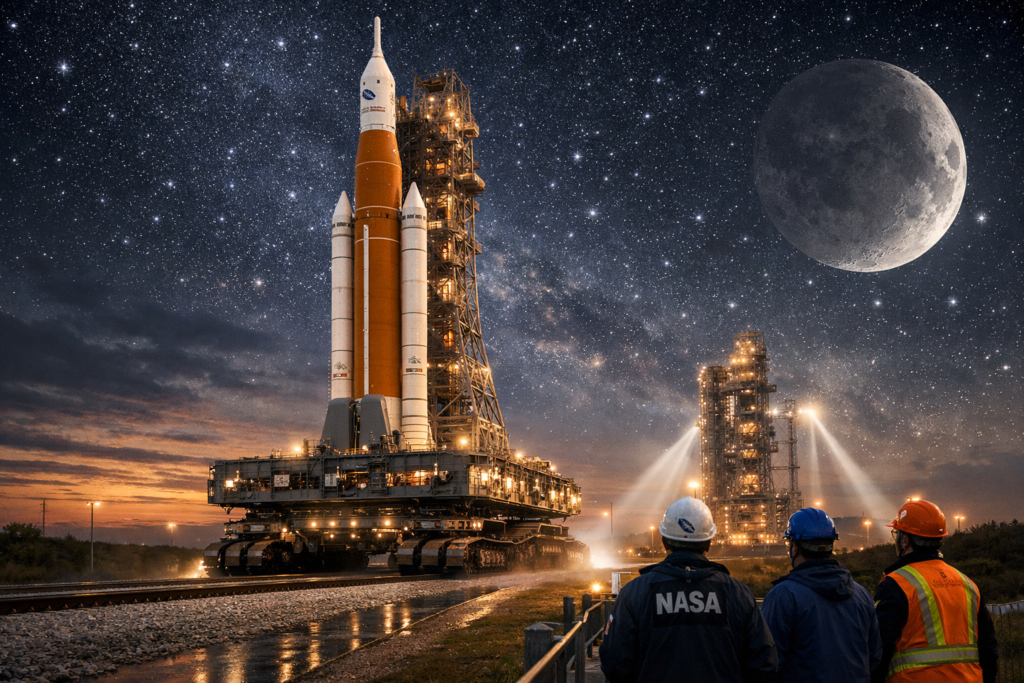
KENNEDY SPACE CENTER, FL — NASA has reached a historic milestone in its ambitious Artemis program with the rollout of the Artemis II Space Launch System (SLS) rocket and Orion spacecraft from the Vehicle Assembly Building (VAB) to Launch Pad 39B at the Kennedy Space Center. This massive move marks a crucial step in the countdown to the first crewed lunar mission since the Apollo era and signals the final phases of prelaunch preparations for a mission that could lift off as early as February 6, 2026.
The Artemis II rollout — slated to begin no earlier than Jan. 17, 2026 — involves transporting the fully integrated rocket and spacecraft stack nearly four miles on NASA’s legendary Crawler-Transporter 2, advancing slowly at about one mile per hour along the specially engineered crawlerway. The journey, which can take up to 12 hours, will position the 322-foot-tall launch vehicle and crew capsule in place for a wet dress rehearsal and final testing before liftoff.
A Historic Step Toward a Return to the Moon
The Artemis II mission represents a defining moment in human space exploration history. It will be the first time astronauts leave Earth orbit and travel into deep space aboard NASA’s powerful Space Launch System and Orion spacecraft, a goal that has been decades in the making since the final Apollo mission in 1972. Unlike Artemis I — an uncrewed test flight that looped around the Moon and returned to Earth — Artemis II will carry four astronauts on a roughly 10-day mission around the Moon and back.
NASA’s Artemis program aims to establish a long-term human presence around the Moon and pave the way for future lunar landings and eventual missions to Mars. Artemis II is a critical stepping stone in that broader strategy, designed to validate spacecraft systems and mission operations with astronauts aboard.
The Rollout: From Vehicle Assembly Building to Launch Pad
The Artemis II rollout is a carefully choreographed, methodical process that highlights decades of launch infrastructure heritage at Kennedy Space Center. The rocket and crew capsule — collectively weighing millions of pounds — will be carried by Crawler-Transporter 2 along a crawlerway bed lined with smooth crushed rock engineered to support the immense weight and minimize vibration.
Once at Launch Complex 39B, teams will conduct the wet dress rehearsal — an integrated test that mirrors key countdown procedures, including fueling the rocket and practicing launch-day operations. This rehearsal is essential before NASA managers decide whether Artemis II is ready for its first crewed flight.
NASA Administrator Jared Isaacman and members of the Artemis II crew are expected to participate in a media event during the rollout, which will be livestreamed on NASA’s official YouTube channel and social media platforms.
Meet the Artemis II Crew — Humans Returning to Deep Space
Artemis II’s four astronauts include:
- Reid Wiseman — Mission Commander
- Victor Glover — Pilot
- Christina Koch — Mission Specialist
- Jeremy Hansen (Canadian Space Agency) — Mission Specialist
This diverse crew will test critical systems aboard the Orion spacecraft as they travel farther from Earth than any humans have gone since the Apollo missions. The mission does not include a lunar landing, but the spacecraft will follow a “free-return trajectory” that loops around the Moon and returns to Earth in a flight lasting about 10 days.
For Glover and Koch, the journey will make history. Koch will become one of the first women to travel beyond low Earth orbit, and Glover could become the first Black astronaut to venture into deep space during this mission.
Technical Preparations and Mission Readiness
The rollout is one of the final major integrated steps before launch. After weeks of stacking the rocket, integrating the Orion capsule, and completing extensive tests, NASA and its partners are now focused on resolving any last-minute technical challenges ahead of the wet dress rehearsal.
NASA’s weather team has released specific criteria that must be met for both the rollout and eventual liftoff — including limits on lightning chances, wind speeds and temperature ranges — to ensure the safety of personnel and equipment during these delicate procedures.
If issues are discovered during the wet dress rehearsal or final checks, the rocket and spacecraft could be rolled back to the VAB for additional work. However, with each milestone met and systems verified, NASA edges closer to a launch that would mark humanity’s first crewed lunar mission in more than half a century.
Why Artemis II Matters — A Prelude to Lunar Landing
While Artemis II will not land on the lunar surface, its success is essential to proving that NASA’s Space Launch System, Orion spacecraft, and deep-space communication and support systems are ready for crewed lunar missions. The lessons learned during Artemis II will directly inform Artemis III, scheduled for a crewed lunar landing — potentially as early as 2027 or 2028 — which aims to set astronauts near the Moon’s south pole and establish long-term lunar operations.
Artemis II also serves a broader purpose beyond lunar exploration. It helps refine spacecraft life support, navigation, deep space radiation shielding and high-speed communication systems — all crucial technologies that will one day support human missions to Mars.
Public Excitement and Global Interest
Public anticipation for Artemis II is high, with space enthusiasts, educators and global audiences tracking every milestone. NASA’s livestreamed rollout events — especially those featuring interviews with commanders and astronauts — are expected to draw large online viewership.
Across international space agencies and scientific communities, the Artemis program is seen as a unifying milestone in space exploration and cooperative human achievement. Artemis II’s success is not just a NASA victory, but a sign of human capability and ambition in deep space exploration.
Looking Ahead: Countdown to Launch
Following the rollout and wet dress rehearsal, NASA will evaluate all readiness data before selecting an official Artemis II launch date, with the launch window opening as early as February 6, 2026. Weather, technical checks and mission assurance reviews will guide that final decision, but if all proceeds smoothly, humanity will soon witness the first crewed lunar mission since the Apollo era.
For millions around the world — from future astronauts to schoolchildren — the Artemis II rollout is a reminder that human exploration of space is entering a bold new chapter. The Moon, once a distant destination, is once again within reach.