Minnesota 2026 Elections: Fraud Scandal and ICE Unrest Reshape Politics
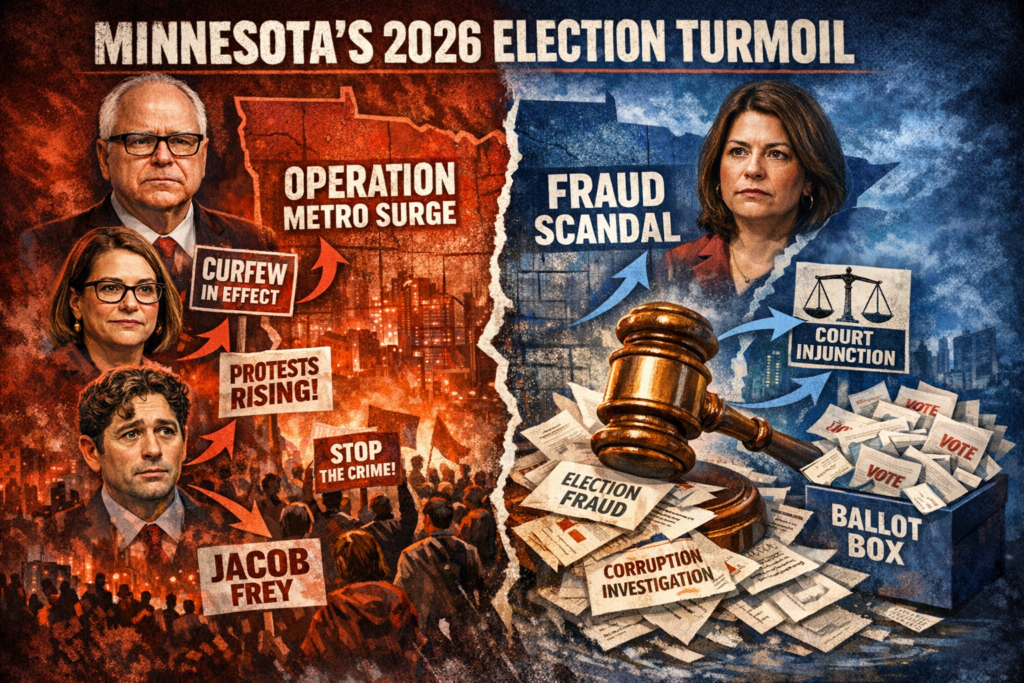
MINNEAPOLIS / SAINT PAUL, Minn. — As the 2026 midterm elections approach, Minnesota — long viewed as a reliably blue state — is confronting an extraordinary combination of political challenges that threatens to reshape its electoral map. A sprawling statewide fraud scandal, coupled with intense unrest over a controversial federal immigration enforcement operation (Operation Metro Surge) and shootings involving federal agents, has thrust the state into the national spotlight and sparked fierce political contests, legal battles, and voter backlash. Republicans are sensing opportunity in a state once considered safely Democratic, while Democratic leaders scramble for damage control against a backdrop of public outrage, court fights, and federal investigations.
At the heart of this upheaval are Minnesota Governor Tim Walz’s political woes tied to a massive welfare fraud case and the controversial federal immigration campaign under the Trump administration that has ignited protests in Minneapolis and beyond. Combined, these crises are molding a volatile political environment that could determine not just statewide offices, but also the balance of power at the national level.
A $9 Billion Fraud Scandal Rocks Democratic Leadership
Minnesota’s Democratic leadership has been blindsided this year by a sprawling welfare and public-assistance fraud scandal that federal prosecutors estimate involved roughly $9 billion in misused state funds — cash originally earmarked for food aid, childcare support, housing and other safety net programs. The fraud allegedly involved more than 90 mostly Somali-descent defendants exploiting state systems.
As the scandal grew from localized allegations into a full-blown crisis, Gov. Tim Walz announced he would not seek re-election, a stunning decision given his prior status as a vice-presidential nominee prospect and one of the state’s most prominent Democratic figures. Republicans — including President Donald Trump and U.S. House Majority Whip Tom Emmer — quickly seized on the issue, using it to attack Democratic governance, poke at public sector integrity, and influence narrative around broader fiscal responsibility issues.
Critics also argue the scandal has sometimes been wielded to stir racial tensions, noting that Somali-American groups were disproportionately represented among defendants, which prompted accusations of stigmatization and harassment of child care centers and businesses operated by Somali Minnesotans. Advocates stressed that punishing actual fraudsters is necessary while also condemning racially charged political exploitation.
As a result, Democrats are now defending vulnerable positions in the upcoming Senate and state legislative races, worried that nationwide Republican messaging paired with local scandals could shift voter behavior in what were once strong Democratic districts.
ICE Enforcement Unrest: A Flashpoint in the Twin Cities
If the fraud scandal damaged Minnesota Democrats from inside, the federal immigration enforcement surge has struck from the outside. In December 2025, the Trump administration launched Operation Metro Surge, deploying more than 2,000 armed Department of Homeland Security (DHS) personnel — including ICE (Immigration and Customs Enforcement) and Border Patrol agents — across the Minneapolis–Saint Paul area under the banner of combating illegal immigration and alleged fraud.
The deployment quickly invited controversy. On January 7, 2026, a 37-year-old Minneapolis woman, Renée Good, was shot and killed by an ICE agent during an enforcement encounter that drew national outrage. Civilian footage and witness accounts quickly contradicted federal claims that the officer acted in self-defense, and protests spread throughout the Twin Cities and other cities nationwide.
Instead of easing tensions, the situation escalated. On January 14, a separate incident involving a federal officer shooting a Venezuelan man in the leg during a traffic stop ignited further unrest, with demonstrators clashing with federal agents and local authorities calling for peaceful protest and restraint.
The unrest has become a defining local political issue — with local leaders and elected officials condemning the federal operation as heavy-handed and unconstitutional. Minneapolis Mayor Jacob Frey called the surge “not sustainable” and claimed it has disrupted communities and instilled fear, especially in immigrant neighborhoods. Minnesota Attorney General Keith Ellison labeled the operation an escalation that threatens fundamental constitutional rights.
In response, Minnesota, along with cities like St. Paul, filed federal lawsuits seeking to halt or restrict the enforcement operation on constitutional grounds, arguing that DHS tactics violate First Amendment rights and state authority. A federal judge also barred ICE from arresting peaceful protesters absent reasonable suspicion — a decision local leaders hailed as critical to protecting civil liberties.
Federal Investigations and Political Weaponization Claims
The political temperature has climbed even higher as the U.S. Department of Justice launched an investigation into whether Gov. Walz and Mayor Frey conspired to impede federal immigration agents — a charge that state leaders decry as politically motivated retaliation by the Trump administration. Critics argue the probe reflects attempts to weaponize the justice system against political opponents rather than uphold constitutional governance.
Democrats, including Minnesota’s congressional delegation, positioned themselves as defenders of civil rights and constitutional protections, asserting that federal actions have trampled local authority and exacerbated divisions. Protests and calls for independent investigations have gained traction, reinvigorating debates over the role of federal power within sanctuary jurisdictions and the appropriate limits of immigration enforcement.
Political Fallout in Key Races
All of this turmoil has meaningful implications for the 2026 Senate race and statewide offices. The Democratic contest to succeed Sen. Tina Smith has tightened significantly, partly due to the fraud scandal and public dissatisfaction over how state leaders handled its fallout. Lt. Gov. Peggy Flanagan and Rep. Angie Craig, both Democrats, are navigating a nomination battle with heightened scrutiny and voter skepticism.
Meanwhile, Republicans are highlighting issues of public safety, federal authority, and immigration enforcement to appeal to moderate and disenchanted voters in what was once one of the nation’s most secure blue states. National GOP figures have actively campaigned in Minnesota, wielding both the fraud scandal and immigration unrest as evidence of Democratic weakness.
Political analysts suggest these issues could tilt the state’s electoral balance, potentially jeopardizing Democratic majorities and reshaping the party’s national strategy. With independents and suburban voters closely watching events, both parties face uphill battles to energize their bases while appealing to undecided constituents concerned about public safety, economic integrity, and procedural fairness.
Nationwide Impact and Broader Narratives
Minnesota’s political turbulence is already capturing national attention. Democratic lawmakers have proposed legislative changes to limit ICE authority nationwide in response to the Minneapolis shootings, while progressive voices renew calls to abolish or reform federal immigration enforcement altogether.
At the same time, Republican resistance to Democratic criticisms and sanctuary policies — echoed in official White House statements blaming local defiance for broader chaos — encapsulates the broader national culture war over federal power, immigration, and law enforcement.
As polling continues in the lead-up to the midterms, experts warn Minnesota will be a bellwether for national politics in 2026, with potential consequences for control of the U.S. Senate and House. The state’s evolving narrative — one of scandal, protest, and political strife — demonstrates just how local crises can quickly become national referendums on leadership, policy, and public trust.