Australia’s Sweeping Social Media Ban Removes 4.7 Million Teen Accounts in First Month
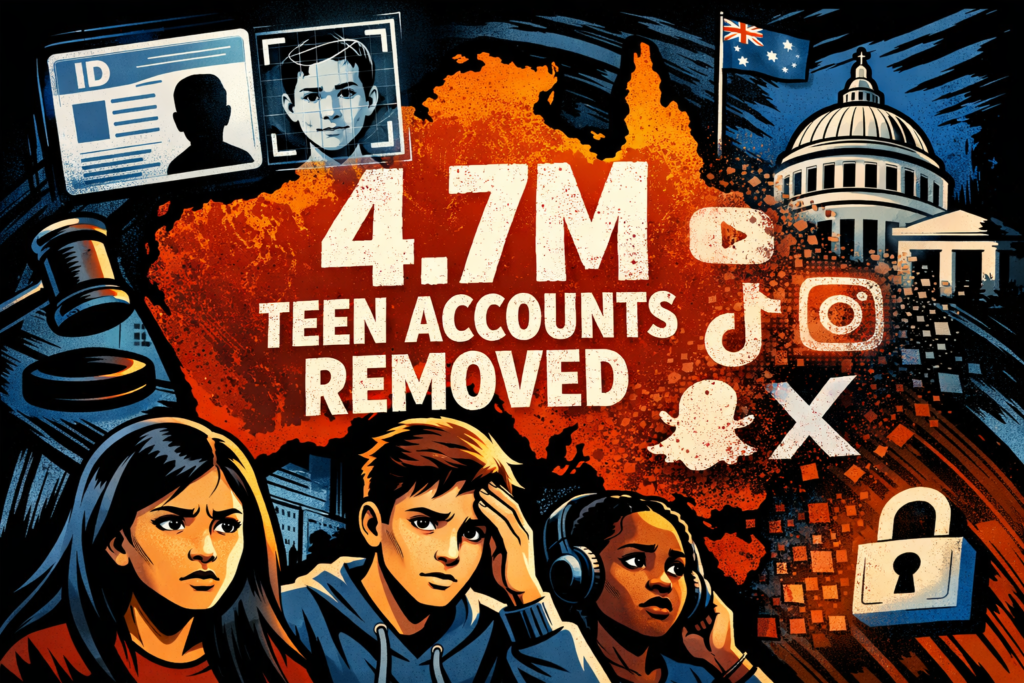
SYDNEY — Just one month after Australia made history by banning individuals under the age of 16 from accessing major social media platforms, government regulators report that about 4.7 million accounts believed to belong to under-16s have been deactivated or restricted — a figure far above early projections and a dramatic early sign of enforcement of the new law. The policy, enacted on December 10, 2025, is being closely watched around the world as a groundbreaking attempt to curb online harm to minors and reshape how societies regulate the digital lives of children.
Australia’s Online Safety Amendment (Social Media Minimum Age) Act 2024 requires tech companies — including Meta’s Instagram, Facebook and Threads, Google’s YouTube, TikTok, Snapchat, X (formerly Twitter), Reddit, Twitch and Kick — to take “reasonable steps” to prevent under-16s from holding accounts on their platforms or face heavy fines of up to A$49.5 million (about US$33 million) for non-compliance.
“We’re preventing predatory social media companies from accessing our children,” said Julie Inman Grant, Australia’s eSafety Commissioner, in response to the latest statistics. “These figures show that around the world, companies can act to safeguard kids online when there’s political will and regulatory clarity.”
Unprecedented Rollout Yields Millions of Deactivated Accounts
According to the first official data on compliance — released by the eSafety Commission — platforms have collectively removed or restricted nearly five million accounts held by users under 16 since the ban went into effect in December. The tally far exceeded government estimates, suggesting that many children had multiple accounts across platforms, or that account duplication and bots were also swept up in the purge.
Meta alone reported deleting more than 550,000 underage accounts from Instagram, Facebook and Threads. Other platforms have not broken down their figures by service, but all 10 companies covered by the ban said they were complying with reporting requirements and taking action to enforce age checks.
The ban does not criminalize children or parents for using social media — its entire burden of compliance falls on the companies themselves. Officials say that failure to cooperate could result in fines of nearly AU$50 million per violation, among the largest penalties in any digital safety regime.
Age Verification Technology and Enforcement Challenges
To enforce the ban, tech companies must rely on age-verification methods such as government ID checks, facial age estimation technologies, or analysis of existing user data like the age of registration. While enforcement has been broad, age-assurance experts caution that effective verification will take time to refine and that some underage accounts remain active.
Prime Minister Anthony Albanese called the results “a clear sign the law is working,” though he admitted it was too early to declare the initiative a resounding success. One major challenge is that teens and their parents are sharing tips on how to bypass the ban, including the use of VPNs, fake IDs, or secondary accounts through friends and relatives — a chilling signal that tech restrictions alone may not be enough to end underage usage.
Albanese said additional resources — including a $700 million mental health support fund — were being mobilized to help young people adjust to the new policy while supporting research into the law’s effects on wellbeing, academic performance, and social behavior.
Public Reaction: Parents, Teens and Advocacy Groups Push Back
The sweeping ban has drawn praise from many parents and child safety advocates who believe that social media is linked to rising levels of anxiety, depression, cyberbullying and body image issues among children. “This gives kids back their childhoods,” Communications Minister Anika Wells said, emphasizing that protecting children from addictive algorithms and harmful content was a national priority.
However, opposition voices have also emerged. Teenagers and privacy advocates argue that social media plays a vital role in fostering peer communication, creativity and identity formation — particularly for youth in remote or rural areas where online communities can be essential social spaces. Critics claim the ban may push children toward alternative platforms not covered by the law or lead them into riskier corners of the internet.
Meta itself has publicly criticized the ban, urging collaboration on age-appropriate digital experiences rather than outright exclusion, and calling for enhanced verification at the app store level. Company leaders warn that even with account removal, algorithmic content can still expose minors to harmful material, prompting complex debates on policy efficacy.
Global Impact and Similar Laws on the Horizon
Australia’s bold move is already influencing global discussions on child safety online. Lawmakers in France, Malaysia and Indonesia have announced plans to consider comparable legislation aimed at regulating youth access to social platforms, and some European governments and U.S. states are watching the rollout closely.
Supporters of the ban argue that digital platforms wield unprecedented influence over childhood development and mental health, and regulatory action is overdue. Opponents worry about future restrictions on digital rights and the potential fragmentation of the global internet based on age or nationality.
What Comes Next: Long-Term Study and Technology Evolving
The Australian government plans to conduct multi-year studies with mental health experts to measure the effect of the ban on youth wellbeing, social skills and academic performance — the very benchmarks that motivated the law’s creation. Officials stress that it will take time to assess whether the initial removal of millions of accounts leads to measurable improvements in the lives of young Australians.
Meanwhile, tech platforms are exploring more robust age-verification systems and broader use of AI-based identification checks to ensure compliance and reduce underage account creation. Digital watchdogs will also monitor emerging apps that initially avoided the law’s scope, adding new layers of regulation and oversight in the months ahead.
Australia’s Policy Significance: A Digital Turning Point
Australia’s world-first social media ban for under-16s has set a global precedent — and its early impact underscores how technology policy can swiftly reshape the digital habits of a generation. The initiative’s effectiveness will ultimately hinge on enforcement, technological innovation, cultural adaptation, and comprehensive assessment of both benefits and unintended consequences.
One thing is clear: governments and tech companies alike are grappling with how to protect children in an increasingly connected world — and Australia’s bold experiment is likely to reverberate far beyond its shores.