GOP Lawmakers Say Trump Given “Bad Advice,” Criticize Policies Without Direct Confrontation
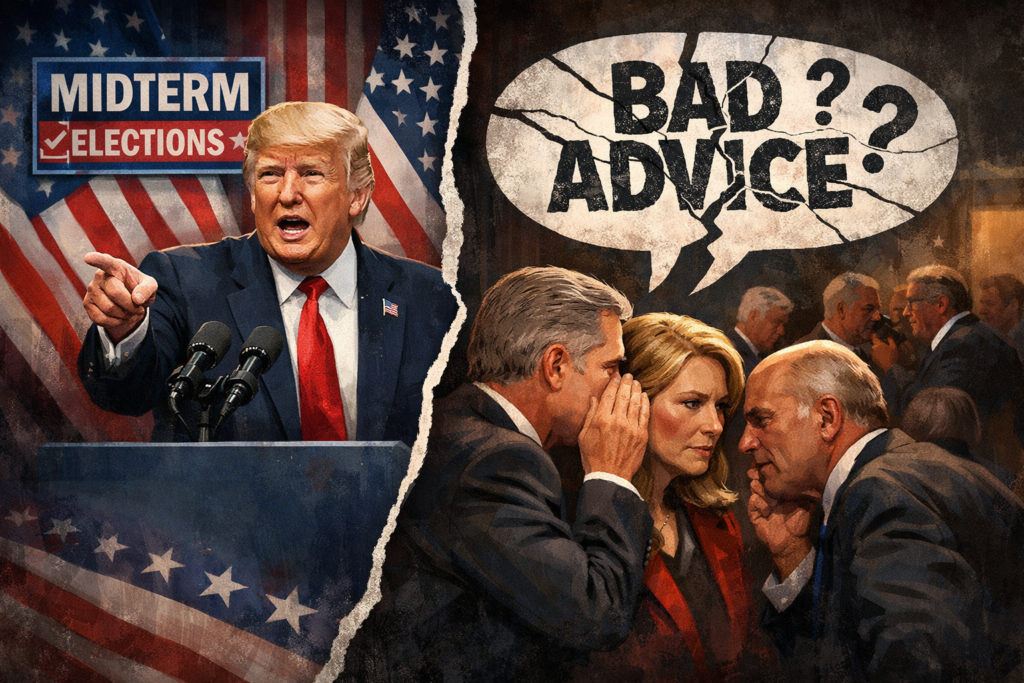
WASHINGTON, D.C. — As President Donald Trump’s second term enters a critical stretch ahead of the 2026 midterm elections, growing numbers of Republican lawmakers are quietly — and sometimes publicly — pushing back against key elements of his policy agenda. But instead of openly rebuking the president himself, many GOP critics have adopted a distinct line of defense: they argue that Trump isn’t wrong — rather, he’s received bad advice from aides and advisers pushing questionable policy ideas. This tactical criticism highlights rising tensions within the Republican Party over Trump’s direction, messaging and bigger economic and foreign policy initiatives.
Almost a year into Trump’s presidency, the strategy has provided Republican figures with a way to distance themselves from controversial policies — from Arctic ambitions to trade proposals and Federal Reserve pressure — without directly attacking the president or destabilizing the party ahead of crucial elections.
The “Bad Advice” Narrative Takes Center Stage
Sen. Thom Tillis (R-N.C.) has become one of the most vocal proponents of framing Republican critiques around the idea that the president has been misled. Tillis, who announced he will not seek re-election, has frequently suggested Trump has acted on “bad advice” on multiple issues — including the controversial rhetoric about seizing Greenland, attacking Federal Reserve Chair Jerome Powell, and in some judicial nomination disputes.
Tillis softened the blow by rarely pointing the finger directly at Trump’s decision-making ability, instead signaling that senior advisers — often unnamed — may have steered policy in impractical or politically hazardous directions. “The president has been given bad advice, and whoever gave him bad advice should probably not be in that role,” Tillis told NBC News in a recent interview delineating Republican discomfort with some presidential talking points.
This rhetorical approach has allowed Republican critics to maintain party unity while acknowledging concerns within the GOP about how certain policy positions could affect Republican prospects in November and beyond.
Policy Disagreements Revealing Internal Divisions
Some of the most vivid examples of this trend emerge in debates over Trump’s foreign policy ambitions — notably his repeated talk about U.S. strategic “control” over Greenland and provocative rhetoric around expanding U.S. reach in Arctic geopolitics. Although Trump often frames these ideas as pragmatic national security measures, many Republicans privately and publicly dismiss them as impractical or unpopular.
House Speaker Mike Johnson (R-La.), for example, downplayed the idea that U.S. military takeover or forceful acquisition of Greenland was truly under serious consideration. Johnson insisted last week that “I don’t think anybody’s seriously considering that,” reflecting a broader pattern among GOP leaders: support for Trump — but skepticism about some of his most ambitious or headline-grabbing ideas.
Similarly, Republicans have signaled frustration with some of Trump’s economic ideas that deviate from traditional conservative orthodoxy. Proposals such as imposing a 10% cap on credit-card interest rates and mandating broader regulations on mortgage giants had party economic conservatives openly questioning the source of such policy advice — even as they hesitated to directly critique the president.
“This bad advice narrative gives Republican officials a way to express concern without sparking primary challenges or appearing disloyal,” said one GOP strategist familiar with internal discussions. “A lot of these lawmakers are worried about how these policies play in their districts — and they use the ‘bad advice’ framing to try and correct course.”
A Fractured Consensus on Economic and Monetary Policy
Another flash point in the debate involves the Trump administration’s persistent criticism of Federal Reserve Chair Jerome Powell and its efforts to pressure the Fed on interest rate policy. Some Republican lawmakers have openly rebuked Trump’s approach. For example, Senator Lisa Murkowski (R-Alaska) praised Tillis’s opposition to Trump’s hardline stance against Powell’s independence, asserting that controversies over central bank leadership should not be handled through prosecutorial pressure or political influence.
Murkowski and others have framed their criticisms by suggesting Trump’s advisers have steered him toward actions that risk hurting long-term economic credibility — again, implying that unilateral presidential strategy is not the central issue, but rather external guidance and internal counsel.
Critics argue that applying undue pressure on the Federal Reserve undermines institutional autonomy and risks economic instability — even as Trump insists that lowering rates is essential for economic growth. This internal GOP disagreement illustrates the broader friction over how Trump’s policy instincts are being shaped and executed.
Political Implications Ahead of 2026 Midterm Elections
Republican concern over Trump’s leadership and policy trajectory is not occurring in a vacuum. Recent polling suggests the Republican Party’s standing among independent voters on key economic issues — especially affordability, health care, and inflation — has weakened relative to previous cycles. Democrats have increasingly highlighted economic concerns as central talking points, using GOP policy divisions as evidence of Republican governance failures.
In this politically charged environment, the “bad advice” narrative enables Republican lawmakers to push back without destabilizing GOP voter support. “It allows them to signal: ‘Yes, we want conservative outcomes, but we disagree with some of the tactics or the framing’,” said a political analyst. “It’s a discreet form of dissent that doesn’t burn bridges.”
But this strategy also underscores a deeper challenge: the GOP’s reliance on Trump’s political brand, even as some of his policy ideas raise eyebrows within the party. Many Republicans are hesitant to openly defy Trump, fearing backlash from his base — yet they recognize that unresolved pushback could cost them broader appeal in 2026 and beyond.
Critics vs. Loyalists: A Balancing Act Within GOP Ranks
Not all Republicans are willing to publicly associate with indirect criticism. Many loyalists continue to defend Trump’s leadership style and policies, framing dissent as the result of media misrepresentation or Democratic political spin. Others argue that “bad advice” framing is a weak critique that ultimately fails to grapple with substantive policy differences.
At the same time, movements within GOP ranks — such as Republican Accountability Project — have existed for years highlighting discontent among Republicans with Trump’s leadership and influence on party direction. These internal currents have only become more relevant as the Republican Party navigates the complex political landscape ahead.
What It Means for the GOP’s Future
As the party prepares for upcoming electoral battles, the delicate balancing act between loyalty to Trump and independent judgment on policy will remain a defining story of the GOP. The “bad advice” mechanism allows Republicans to critique without catastrophic political damage — but it also highlights how deeply Trump’s influence has redefined GOP consensus and allegiance.
Whether this narrative will help the party refine its message and policy priorities — or merely paper over deeper disagreements — remains uncertain. With midterms approaching and public attention on inflation, foreign affairs, and economic stewardship, Republicans may find themselves forced to convert cautious critiques into firmer stands.
For now, the “bad advice” strategy offers a pathway for Republicans to voice discomfort without rupture — reflecting both political calculation and a subtle reshuffling of power and responsibility within the party.