NASA Conducts First-Ever Medical Evacuation From ISS as Crew-11 Returns Early to Earth
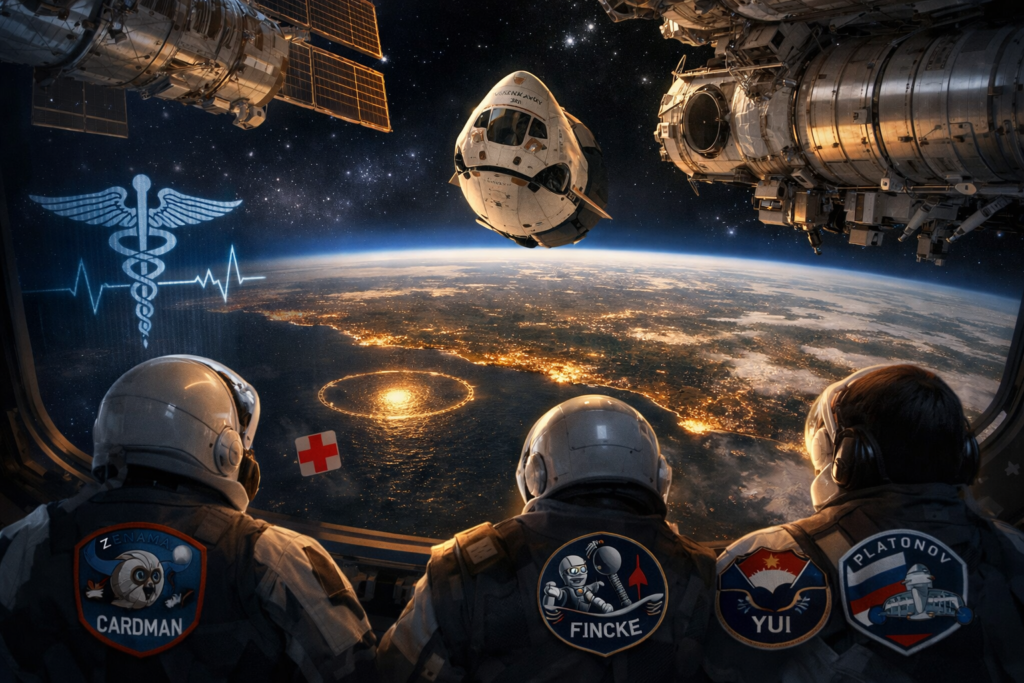
WASHINGTON, D.C. / SPACE — In a historic and rare maneuver, NASA has ordered the early return of four astronauts from the International Space Station (ISS) after a medical concern involving one of the space travelers aboard the orbiting lab, marking the first medical evacuation in the ISS’s 25-year human spaceflight history. The SpaceX Crew-11 mission, originally scheduled to stay in orbit until mid-February 2026, splashed down safely off the coast of California on Jan. 15, 2026, ending a scientific journey of 167 days due to a precautionary shift in plans triggered by a health issue that could not be adequately diagnosed or treated in space.
The early departure — carefully planned and controlled rather than a panic evacuation — underscores NASA’s unwavering commitment to astronaut health and safety while highlighting both the limits and growing capabilities of medical support in microgravity environments.
Medical Concern Aboard the ISS Prompts Historic Decision
NASA announced on Jan. 8, 2026, that it was planning the earliest end to an ISS mission in a quarter-century after one of the Crew-11 astronauts experienced a serious but undisclosed medical issue. While the affected individual’s condition was described by agency officials as stable, doctors and mission planners determined that “the best way to complete that workup is on the ground,” reflecting the limits of onboard medical diagnostic capabilities.
Because of medical privacy protocols, NASA has declined to publicly name the astronaut or reveal the specific symptoms or diagnosis, a standard practice to protect personal health information. Still, agency leaders emphasized that the decision was driven by precaution and prudence rather than an imminent crisis.
Before the decision, NASA also postponed planned spacewalks — including a major extravehicular activity originally scheduled for Jan. 7 — to allow flight surgeons more time to monitor the situation and adjust plans accordingly.
Crew-11: A Diverse International Crew Returns Home
The four Crew-11 astronauts aboard the SpaceX Crew Dragon Endeavour who returned early included:
- NASA astronaut Zena Cardman (Commander)
- NASA astronaut Mike Fincke (Pilot and ISS Expedition 74 leader)
- Japan Aerospace Exploration Agency (JAXA) astronaut Kimiya Yui
- Roscosmos cosmonaut Oleg Platonov
Their mission began on Aug. 1, 2025, when Crew-11 launched from NASA’s Kennedy Space Center in Florida aboard a Falcon 9 rocket and docked with the ISS, where they contributed to science, experimentation, station maintenance, and international cooperation in space exploration.
Despite an unexpected ending, the return was smoothly executed: after undocking from the Harmony module of the ISS, the capsule re-entered Earth’s atmosphere and performed a parachute-assisted splashdown in the Pacific Ocean off Southern California early on Jan. 15, 2026. Recovery teams were on hand to assist all four crewmembers, and initial medical evaluations indicated the returning astronauts were in good condition.
During the descent and post-splashdown press comments, Commander Cardman described the experience as “bittersweet,” noting how the crew functioned like a close family unit even as their mission was cut short.
Historic First Medical Evacuation in ISS Operations
While medical events have occasionally affected space missions, this is the first time a medical concern has led to an entire ISS crew being brought home early. NASA officials stressed that, historically, crews have adapted to minor illnesses or used onboard medical tools. Still, in this case, a returning descent was judged to offer better clinical assessment and care.
NASA Administrator Jared Isaacman highlighted the importance of designing human spaceflight programs that can handle in-orbit health challenges, particularly as agencies worldwide consider deep space missions to the Moon and Mars where medical autonomy will be even more critical.
The decision also reflects evolving medical planning principles learned from decades of human spaceflight — from the early Space Shuttle era to long-duration ISS expeditions — where contingency planning remains essential to mission success.
Command Ceremony and Transition Aboard the ISS
Before leaving, Crew-11 conducted a formal change-of-command ceremony aboard the ISS on Jan. 12, 2026, transferring station authority to Russian cosmonaut Sergey Kud-Sverchkov, who, along with fellow Roscosmos cosmonaut Sergey Mikayev and NASA astronaut Chris Williams, will maintain ISS operations until the next crew arrives.
Such ceremonies highlight the collaborative international partnership that has characterized the ISS since its inception, with leadership roles rotating among NASA, Roscosmos, JAXA and other partners.
With Crew-11’s departure, the station temporarily operates with a reduced crew of three, meaning that routine spacewalks, scientific experiments and maintenance operations may require adjusted schedules or be postponed until the next Crew-12 team arrives.
ISS Operations Adjustments and Future Plans
NASA and its international partners are now focusing on accelerating the launch of the SpaceX Crew-12 mission, currently planned for mid-February 2026, to restore full staffing levels aboard the ISS and resume normal operations.
Down on Earth, medical teams at NASA’s Johnson Space Center in Houston are prepared to conduct comprehensive evaluations of the astronaut whose health triggered the early departure, part of the agency’s commitment to astronaut welfare.
Additionally, the ISS program continues to plan for future research and exploration goals, including advancing extensive scientific studies in microgravity that benefit life on Earth and inform long-duration human missions to lunar orbit and beyond.
The Significance of Prioritizing Health in Space
Although space agencies always train for contingencies, the early return of Crew-11 underscores the inherent challenges of living and working in microgravity, where medical support is limited compared with Earth-based facilities. NASA officials emphasize that crew health and safety come first, and missions must be flexible to adapt to unexpected developments.
This decision could inform future protocols for medical care in space, including new technologies, telemedicine, and improved onboard medical tools that enable astronauts to receive more advanced diagnostic support while in orbit.
As NASA and partners analyze this event, the space community will likely draw from lessons learned to ensure that human spaceflight remains both ambitious and safe for those pushing the boundaries of exploration.