Greenland and Denmark Face High-Stakes Talks With U.S. as Trump Pushes for Arctic Control
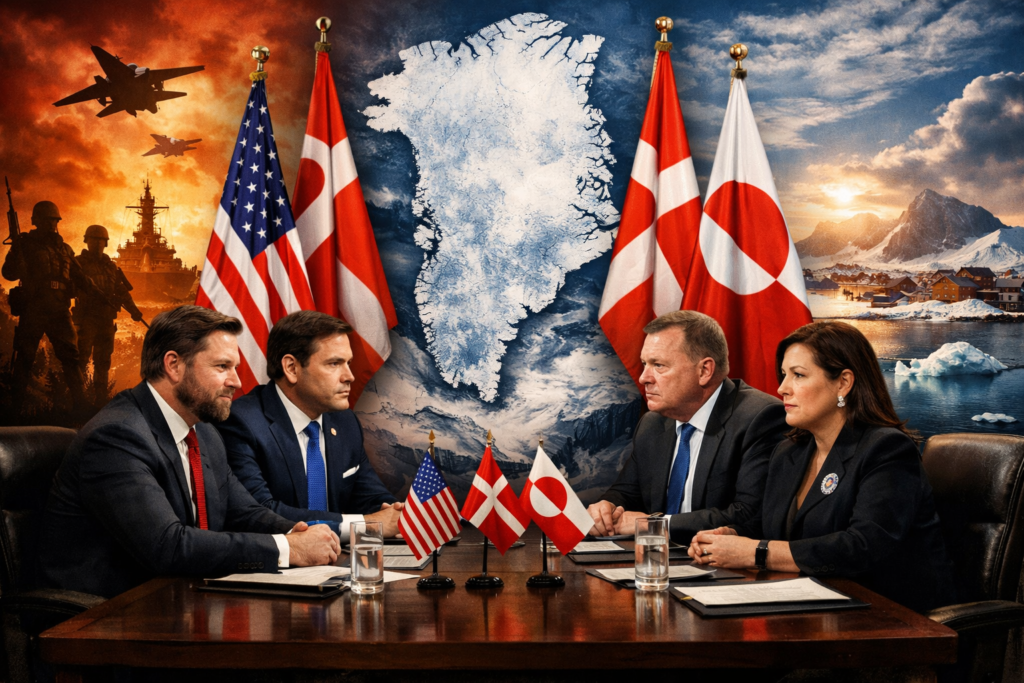
WASHINGTON, D.C. / NUUK — In a diplomatic standoff capturing global attention, the foreign ministers of Denmark and Greenland are set to meet with U.S. Vice President J.D. Vance and Secretary of State Marco Rubio at the White House, amid renewed comments by President Donald Trump about acquiring control of Greenland, the autonomous Arctic territory of the Kingdom of Denmark. The high-level meeting, scheduled for Wednesday, January 14, 2026, reflects escalating geopolitical tensions over the future of the island and broader concerns about Arctic security, sovereignty, and alliance unity. This diplomatic encounter comes after weeks of increasingly forceful rhetoric from Trump — including suggestions that the United States should take control of Greenland “one way or another” for strategic reasons — a stance that has alarmed Copenhagen and Nuuk and raised serious questions about NATO cohesion and respect between long-standing allies.
A Meeting Born of Controversy and Escalating Rhetoric
Danish Foreign Minister Lars Løkke Rasmussen and Greenlandic Foreign Minister Vivian Motzfeldt requested the White House talks with U.S. officials after Trump’s statements intensified concerns in Europe over Washington’s intentions for Greenland, an island of roughly 57,000 people with significant mineral resources and a strategic Arctic position. Trump’s arguments for U.S. control — whether through purchase, negotiation, or implied pressure — center on the belief that Greenland’s location and evolving Arctic security landscape make it too critical to be left solely under Danish authority. The U.S. and other global powers, notably Russia and China, have shown growing interest in the Arctic as climate change opens new shipping lanes and access to natural resource deposits. At Tuesday’s press briefing in Copenhagen, Rasmussen highlighted that the meeting was sought to “look each other in the eye and talk through these issues,” emphasizing the need for frank, direct dialogue rather than heated public statements. In a rare unified message, the leaders of Greenland and Denmark said they would not accept Trump’s push to transfer sovereign authority, emphasizing instead their right to self-determination and longstanding ties to Denmark and NATO.
Greenland’s Government: “Unfathomable” and Firm on Denmark
Among the most striking reactions to the U.S. rhetoric came from Naaja Nathanielsen, Greenland’s minister for business and mineral resources, who called it “unfathomable” that the United States might consider taking over the island, a territory that has worked cooperatively with Americans but does not want to become part of the U.S. “We have no intentions of becoming American,” Nathanielsen said, urging Washington to listen to Greenlanders rather than pursue a unilateral agenda. “For others this might be a piece of land, but for us it’s home.” Her comments reflect broad local sentiment in Greenland, where many residents prefer to remain part of the Kingdom of Denmark under NATO protection rather than become subject to competing ambitions. At a joint press conference ahead of the talks, Greenlandic Prime Minister Jens-Frederik Nielsen and Danish Prime Minister Mette Frederiksen reiterated that “We choose Denmark… We choose NATO… We choose the EU” if forced to choose between alliances, leaving little doubt about their priorities.
NATO, Allies, and Arctic Security Concerns
European and NATO officials have tried to strike a balanced approach, urging unity and cooperation on Arctic security issues without reigniting old tensions between Washington and its closest allies. NATO’s Secretary-General has avoided direct commentary on the dispute but underlined the alliance’s role in collective defense in the Arctic region. Denmark and Greenland have also increased their Arctic defense investments. Copenhagen recently committed significant funds toward Arctic security, aiming to reassure allies and assert its role as an active NATO member while calming fears that the United States might unilaterally dominate the region. At the heart of the talks is the broader question of how Arctic nations can balance national sovereignty with shared security interests. Analysts say Greenland’s strategic value — from its proximity to North America and Europe to its airbases and monitoring capabilities — makes it a vital piece in the complex chessboard of global power projection.
Local Greenland Voices: Diplomacy Over Domination
Across Greenland, citizens and political figures alike are pressuring all sides for a diplomatic outcome. Many Greenlanders say that while they understand America’s security concerns, any push for control through force or political pressure is unacceptable. Some Greenlanders hope the diplomatic talks will result in expanded cooperation on economic development and Arctic scientific research, rather than a sovereignty dispute. Community leaders have urged both the United States and Denmark to emphasize mutual respect and shared goals, rather than headlines about control or acquisition.
The U.S. Perspective: Security and Strategic Interests
From Washington’s perspective, proponents of a more assertive stance on Greenland argue that its geopolitical significance cannot be understated. U.S. officials, including Vice President Vance in remarks during earlier diplomatic visits, have emphasized that a strong American presence and heightened awareness are essential for defending against potential adversaries in the Arctic, including Russia and China. In conversations with lawmakers and diplomats, U.S. representatives have highlighted the need to collaborate with NATO allies while also protecting American national security interests — a delicate balance as Arctic ice recedes and global competition intensifies. Though Trump has repeatedly stated he prefers a negotiated solution — including the possibility of “making a deal” to reassure U.S. needs — his frequent comments about one way or another obtaining Greenland have put pressure on diplomatic channels and provoked strong pushback from European allies.
Looking Ahead to White House Talks
With the scheduled White House meeting just days away, expectations are high that Copenhagen and Nuuk will seek reassurances that U.S. intentions are grounded in cooperation and respect for sovereignty. Observers are watching closely to see whether Washington shifts its tone from aggressive rhetoric to partnership-oriented diplomacy.
As diplomatic envoys prepare, leaders from Denmark and Greenland are clear: Greenland is not for sale, and its future will be determined by its people, not by foreign pressure or geopolitical maneuvering.