Hundreds More Federal Agents Deployed to Minnesota After Fatal ICE Shooting and Rising Tensions
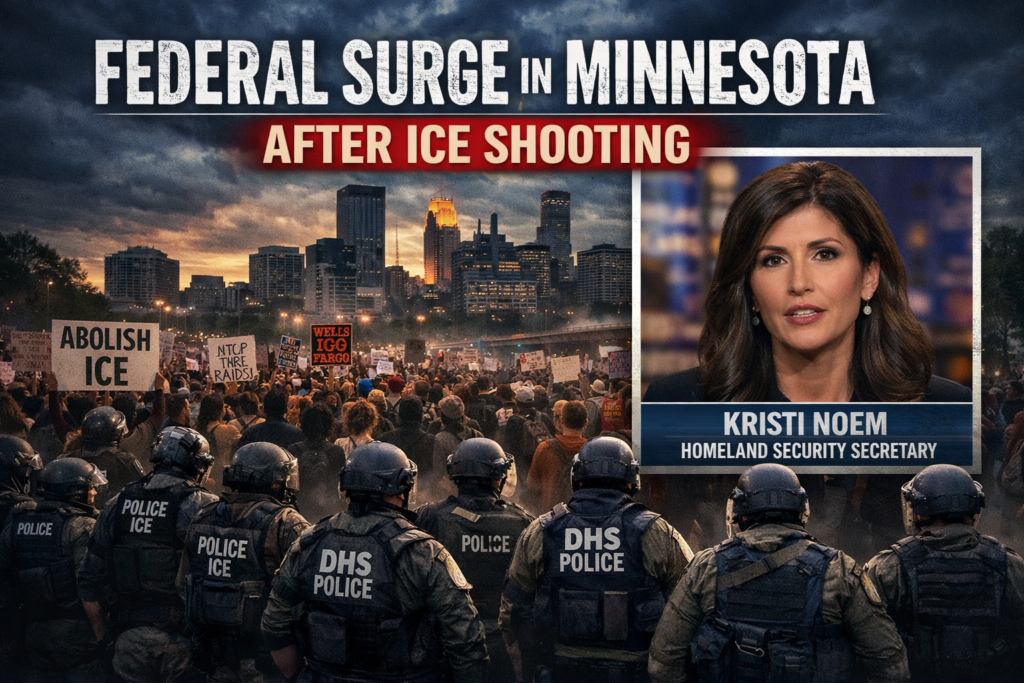
MINNEAPOLIS — Federal authorities announced on Sunday that hundreds more federal agents are being sent to Minneapolis-Saint Paul, Minnesota, to reinforce an already substantial federal presence after the fatal shooting of a local woman by an Immigration and Customs Enforcement (ICE) officer sparked nationwide protests and heightened tensions between community leaders and the Trump administration. Homeland Security Secretary Kristi Noem said the additional agents will arrive over the next two days to protect federal personnel and support ongoing immigration enforcement operations. The deployment builds on what the U.S. Department of Homeland Security (DHS) describes as the “largest immigration enforcement operation ever” in the Twin Cities — a sweeping surge now involving more than 2,400 federal agents from ICE, U.S. Customs and Border Protection (CBP), and Homeland Security Investigations (HSI).
A Fatal Encounter That Set Off Nationwide Protests
The unfolding federal surge follows the Jan. 7 shooting of Renée Nicole Good, a 37-year-old Minneapolis resident and mother of three, by an ICE officer during a contentious immigration operation. Federal authorities claimed the officer acted in self-defense after Good’s SUV struck him, but local officials and videos viewed by protesters and civil rights groups suggest the vehicle was turning away when the fatal shots were fired. Good’s death ignited widespread outrage, particularly among immigrant rights advocates and community allies, who accused ICE and federal officials of using excessive force and exaggerating threats to justify escalation. In response, tens of thousands of protesters marched through downtown Minneapolis on Saturday, with demonstrations spreading to cities across the United States — from Los Angeles to Salt Lake City. Local leaders, including Minneapolis Mayor Jacob Frey and Minnesota Governor Tim Walz, have harshly criticized the federal narrative, pressing for full transparency and state participation in the ongoing investigation. Some officials have even accused the FBI of limiting cooperation with local law enforcement — a move they say undermines trust and fuels deeper suspicion about federal motives.
Noem’s Comments and Federal Justification
Appearing on Fox News’s “Sunday Morning Futures,” Secretary Kristi Noem emphasized that the additional federal officers are being sent to ensure the safety of ICE and Border Patrol personnel already in Minnesota amid days of protests and occasional clashes. “We’re sending more officers today and tomorrow,” Noem said, “there’ll be hundreds more in order to allow our ICE and Border Patrol individuals that are working in Minneapolis to do so safely.”
Noem and other supporters of the expanded federal deployment have framed the actions as necessary to combat rising hostility toward federal agents, arguing that threats and violent acts against law enforcement — including vehicular attacks — have surged in recent years. Noem has also linked the wider operation to a fraud investigation involving welfare and pandemic aid programs in Minnesota, asserting that the state has become a focal point for both illegal immigration and financial crime.
“Sanctuary politicians are allowing situations around the country to become volatile,” Noem said, accusing local officials like Frey and Walz of failing to support federal enforcement efforts and of shielding criminal actors under the guise of progressive policies.
Local Backlash and Calls for Accountability
Despite the federal government’s position, Minnesota’s political leadership and civil rights advocates sharply reject the narrative that federal forces are acting purely in defense. Mayor Frey described federal statements about the shooting and subsequent deployment as politically charged and premature, saying video evidence contradicts claims that Good posed a direct threat to the officer. Frey has also called for transparent state oversight of the investigation and greater inclusion of local law enforcement, rather than a federal-only probe. Thousands of protesters remain active in Minneapolis, with many calling for the removal of ICE from the city entirely. Organizations like the Minnesota Immigrant Rights Action Committee (MIRAC) have staged rallies and erected makeshift memorials to honor Good’s memory, tying her death to broader frustrations over immigration policy, racial injustice, and lack of accountability for federal agents.
National Debate Over Federal Law Enforcement Presence
The deepening federal operation in Minnesota has reignited a bitter national debate over the appropriate scope and role of federal immigration agencies. Supporters of the deployment argue that aggressive enforcement is vital to national security, especially in areas perceived as having porous local policies or high rates of undocumented immigration. Opponents, however, see the surge as a form of federal overreach that undermines community trust and fuels fear among immigrant communities already skeptical of law enforcement. Civil liberties groups have also raised alarms about militarization of public spaces, arguing that the sheer number of armed agents — outnumbering local police in some areas — exacerbates tensions rather than reduces them. Demonstrators and critics alike warn that without clear oversight and restraint, these operations risk inflaming conflict and eroding civil rights protections.
Ongoing Investigations and Legal Implications
Minnesota law enforcement has opened a state criminal investigation into the shooting, prompted in part by concerns that federal authorities have limited local access to the case materials. This has raised complex jurisdictional questions, particularly as federal officials maintain control over the investigation while local leaders push for joint collaboration. The possibility of federal charges, civil litigation, and congressional hearings looms over the case, as lawmakers from both parties debate federal immigration policy and lethal force standards. Some Democratic officials have even threatened to pursue oversight measures or funding restrictions if transparency is not prioritized.
Looking Ahead: Tension, Accountability, and Policy Debates
As the additional federal agents stream into Minnesota, the city remains at the center of a national struggle over immigration enforcement, civil liberties, and local versus federal control. Demonstrations are expected to continue throughout the week, with activists vowing sustained protest and heightened scrutiny of federal tactics.
Whether the increased federal presence restores order or escalates tensions further will depend largely on how authorities engage with communities, handle investigations, and balance enforcement priorities with respect for civil rights. The shadow of Renee Good’s death — and the nationwide outrage it ignited — underscores just how emotionally and politically charged the issue has become.