U.S. Launches ‘Large-Scale’ Strikes on ISIS in Syria in Response to Deadly Ambush
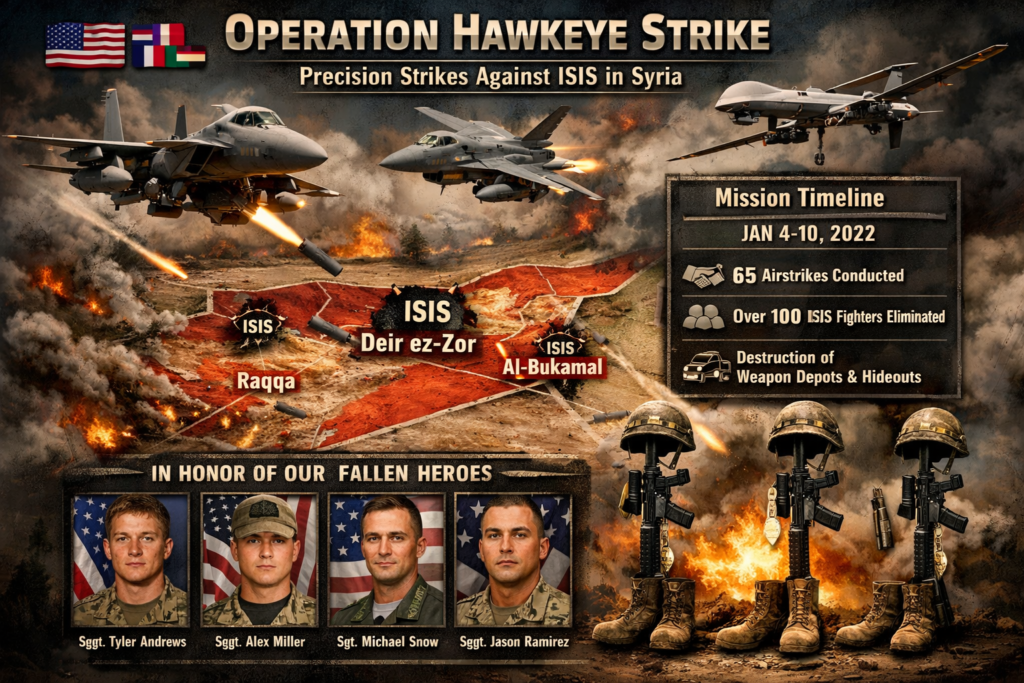
WASHINGTON, D.C. — In a forceful demonstration of military resolve, the United States military conducted a series of “large-scale strikes” against Islamic State (ISIS) targets across Syria on Saturday, January 10, 2026. The operation — described by U.S. Central Command (CENTCOM) as part of Operation Hawkeye Strike — was ordered by President Donald Trump following a deadly ISIS ambush last December that killed two U.S. soldiers and a U.S. civilian interpreter near the ancient city of Palmyra. The Syrian conflict has once again drawn international focus as coalition forces intensify efforts to dismantle the remnants of ISIS, even years after the terrorist group lost its territorial “caliphate.” The latest strikes reflect Washington’s continued commitment to counterterrorism, protect its forces in the region, and deter future attacks by extremist elements.
Operation Hawkeye Strike: A Retaliatory Response
The coordinated military campaign against ISIS in Syria, called Operation Hawkeye Strike, was launched in December 2025 following a devastating ambush on December 13 in which Sgt. Edgar Brian Torres-Tovar, Sgt. William Nathaniel Howard, and Ayad Mansoor Sakat, an American civilian interpreter, were killed. The lone gunman responsible for the attack was believed to be affiliated with ISIS. On Saturday, more than 20 aircraft — including fighter jets and armed drones — conducted strikes across northern and central parts of Syria, hitting at least 35 ISIS positions, including suspected weapons depots, infrastructure sites, and militant hideouts. CENTCOM stated that over 90 precision munitions were deployed during the operation, underscoring the intensity and sophistication of the action. In a public statement, CENTCOM reaffirmed that the strikes were intended to “root out Islamic terrorism against our warfighters, prevent future attacks, and protect American and partner forces in the region,” adding that coalition forces remain committed to pursuing militants who threaten U.S. security.
Coalition and Regional Cooperation
While the United States led the air operation, the strikes were reportedly carried out alongside unnamed partner forces, reflecting ongoing cooperation with regional allies and security forces in Syria. Since the 2024 ouster of former President Bashar al-Assad, Syrian government forces have engaged more directly with coalition partners, including the U.S., in joint anti-ISIS efforts. The attacks come at a strategic moment as Syria’s new leadership seeks a role in global efforts to suppress extremist networks. Syrian officials said their security forces captured a regional ISIS military leader just a day before the U.S. strikes, signaling an increased operational capability in counterterrorism.
Lasting U.S. Commitment Amid Ongoing Threats
The U.S. military still maintains approximately 1,000 troops in Syria, part of a broader mission to prevent ISIS from regaining strength and executing external attacks. Experts warn that although ISIS lost its territorial base in 2019, the group continues to operate in sleeper cells and poses an ongoing threat across Iraq and Syria. Recent U.S. and partner operations have already produced measurable results. Through a series of missions that began in late December, the coalition has killed or detained several ISIS operatives and destroyed multiple weapons caches, according to CENTCOM reports. Operations leading up to Saturday’s wide-ranging strikes included a December 19 offensive that targeted more than 70 ISIS sites across central Syria, using over 100 precision munitions in assaults on critical infrastructure and weapons storage facilities.
The Human Cost Behind Military Action
The December ambush that triggered the U.S. response was a stark reminder of the human toll continued instability in Syria can exact. The deaths of U.S. soldiers and a civilian interpreter in Palmyra marked one of the most serious attacks on American personnel in the region in recent years. Veterans’ groups and military families have expressed a mix of grief and resolve. In public comments, some have praised the decisive action as necessary to honor fallen service members, while others call for sustained diplomatic efforts to prevent future violence. Analysts point out that retaliatory strikes carry risks — including civilian casualties and potential escalation — but are often seen by military leadership as essential tools to disrupt terror networks.
Broader Geopolitical Stakes in Syria
The broader Syrian theater remains complex. The ouster of Assad’s regime in 2024 reshaped alliances. New Syrian leadership has shown willingness to work with Western forces against ISIS, a significant shift from previous opposition. This cooperation has enabled coalition forces to strike targets deep in territory that was once off-limits. Turkey, Iraq, Jordan, and Kurdish-led Syrian Democratic Forces have also contributed to the broader anti-ISIS campaign known as Operation Inherent Resolve, which has been ongoing for nearly a decade. Despite territorial defeat of ISIS, remnants still pose threats, particularly through underground networks and remote regional cells.
No Official Casualty Figures Yet Released
As of this writing, both the Pentagon and the U.S. State Department have not released official casualty figures from the latest strikes. CENTCOM typically provides limited details on friendly or enemy casualties immediately after operations, citing operational security. Reports from Syrian monitoring groups suggest that several ISIS militants may have been killed, though independent verification remains challenging.
Officials have reiterated that the goal of these operations is not escalation but rather prevention, seeking to dismantle terror networks before they can carry out further attacks. The strategy reflects broader U.S. counterterrorism doctrine — pursuing extremist groups aggressively while seeking to limit civilian impact and avoid unnecessary escalation.
Looking Ahead: Future Operations and Strategy
With ISIS driven underground but not eliminated, military and diplomatic planners expect continued operations throughout 2026. Intelligence sharing, regional cooperation, and precise tactical strikes remain central pillars of U.S. strategy in the Middle East. Analysts note that the evolving battlefield in Syria will likely demand flexibility, blending kinetic military action with intelligence and support for local forces. The U.S. government also faces pressure at home to justify ongoing military involvement abroad, balancing national security interests with fiscal and political considerations. Still, the Trump administration has emphasized its redoubled focus on counterterrorism and protecting American forces worldwide. For communities in Syria, the hope is that increased cooperation among security forces will prevent ISIS from regaining territory and provide a measure of stability in areas long disrupted by war. At the same time, humanitarian groups warn that long-standing conflict dynamics — including displacement, poverty, and fractured governance — pose deep challenges to lasting peace.