NASA Orders Historic Early Return of ISS Crew After Astronaut Medical Issue
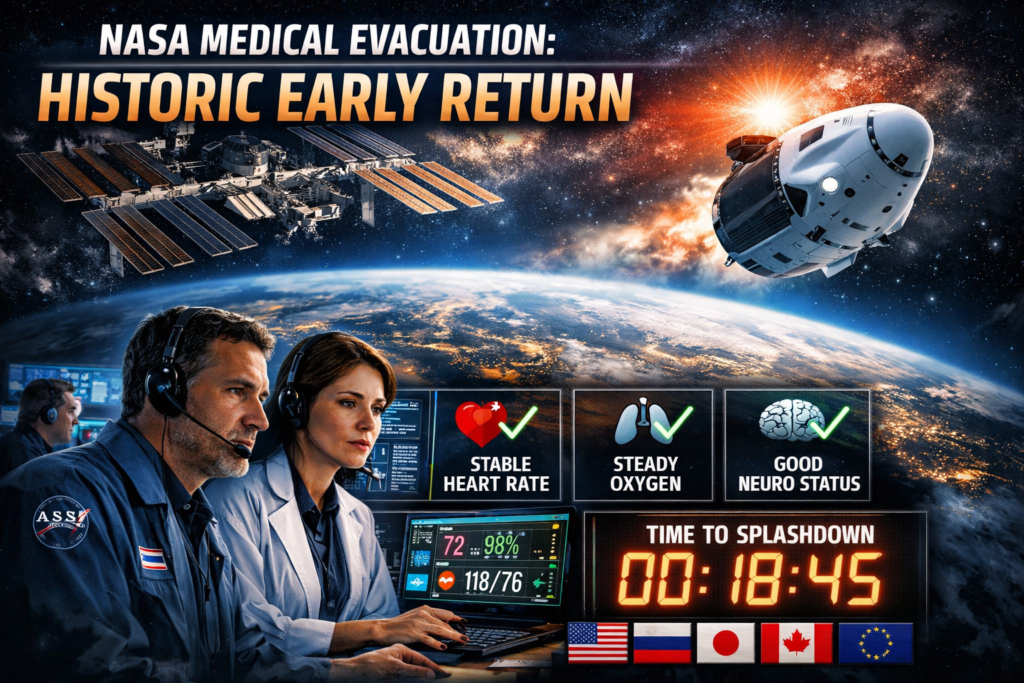
WASHINGTON, D.C. — In a first-of-its-kind decision, NASA has announced that four astronauts aboard the International Space Station (ISS) will end their mission more than a month early due to a medical issue affecting one crew member, officials said Friday. The move marks the first ever medically driven early departure from the orbiting laboratory in its 25-year history, reflecting both the challenges of space medicine and NASA’s commitment to crew safety. Mission planners are now targeting a mid-January departure for SpaceX Crew-11, whose scheduled return to Earth was originally set for mid-February 2026. Although details of the medical condition are being kept confidential out of respect for privacy, agency leaders say the astronaut’s health is stable — yet requires diagnostic tools and care unavailable aboard the ISS.
A Unique Medical Decision
NASA administrators emphasized that the early return is precautionary rather than an emergency evacuation, a reflection of both the seriousness of the situation and the agency’s robust planning for medical contingencies. “Safely conducting our missions is our highest priority,” NASA Administrator Jared Isaacman said during a press briefing. “We are actively evaluating all options, and in this case we believe it’s best to bring the crew home so the astronaut can receive more complete medical care on Earth.” The space station is equipped with medical hardware and 24/7 access to flight surgeons on Earth. But some conditions — especially those requiring advanced diagnostic imaging or treatment procedures — simply cannot be fully evaluated or treated in microgravity. That limitation, officials say, drove the decision. NASA’s Chief Health and Medical Officer, Dr. James Polk, described the affected astronaut as “stable” but acknowledged that certain health questions could only be answered with Earth-based equipment. “We have excellent telemedicine and basic medical tools onboard the ISS,” Polk said. “But in this case, the most thorough evaluation has to take place on the ground.”
Crew-11: A Multinational Mission Cut Short
The returning team is the SpaceX Crew-11 mission, which includes:
- Zena Cardman (NASA),
- Mike Fincke (NASA),
- Kimiya Yui (Japan Aerospace Exploration Agency — JAXA),
- Oleg Platonov (Russian space agency — Roscosmos).
The astronauts launched aboard a SpaceX Crew Dragon Endeavour from NASA’s Kennedy Space Center on August 1, 2025, beginning what was planned as a six-month expedition filled with scientific experiments, station maintenance, and spacewalks. One of the early indicators of the unfolding situation came when NASA postponed a planned spacewalk scheduled for January 8 — a mission Cardman and Fincke were set to undertake to prepare the station for new solar arrays. That cancellation, made shortly after the medical situation arose, was the first public sign that something serious had developed.
Historic Decision Highlights Space Medicine Limits
While astronauts undergo rigorous health screening before launch and travel with advanced medical kits, spaceflight itself presents unique medical challenges. Prolonged exposure to microgravity, altered immune responses, and limited diagnostic capabilities mean that even minor concerns can become significant. However, nothing in NASA’s modern history had ever prompted an early crew departure solely for medical reasons — until now.
Experts say the decision underscores how space agencies must balance mission objectives with human welfare. “This isn’t just about pulling someone off the station,” said space medicine specialist Dr. Lydia Torres, who has consulted on orbital health planning. “It’s an affirmation that no mission is worth jeopardizing an astronaut’s long-term health.”
Although NASA has contingency protocols for medical events — including accelerated returns — this is the first that has resulted in all crew members departing before the next team arrives.
What Happens Next at the ISS
Even with Crew-11’s departure, the ISS won’t be left unmanned. A separate team already aboard — including NASA astronaut Christopher Williams and two Roscosmos cosmonauts — will continue to operate the station, conduct research, and maintain systems until SpaceX Crew-12 arrives, currently slated for launch in mid-February 2026. NASA is reviewing whether that schedule may be accelerated to ensure station operations remain fully supported. The early departure will affect scheduled science experiments and maintenance tasks. Some research — especially long-duration studies that depend on consistent monitoring — may have to be paused or adjusted to align with the reduced crew presence. Space medicine specialists and mission planners will evaluate scientific priorities once Crew-11 returns to Earth.
Astronaut Health and Risk Management in Space
NASA has designed the ISS as a floating laboratory capable of handling many emergencies, but there are inherent limitations. The absence of on-site imaging tools such as CT scanners, MRI machines, and surgical facilities means that certain health questions must be answered on Earth, necessitating difficult decisions like this one. Astronauts aboard the ISS undergo continuous health monitoring, including regular check-ins with flight surgeons and the use of onboard diagnostics. But when a condition is beyond the scope of current space medicine tools, bringing the crew member home for comprehensive care becomes the safest option. Researchers emphasize that while rare, such decisions are always made with crew safety at the forefront.
Global Collaboration and Crew Welfare
Space exploration is an international endeavor, and NASA’s decision affects partners from multiple space agencies. Japan’s JAXA and Russia’s Roscosmos have pledged full cooperation as the early return plan unfolds, and all four astronauts are expected to remain with the returning Crew-11 team rather than leaving a single astronaut behind. This is due to protocols ensuring that every crew aboard the ISS must have an available return seat in case of emergencies.
A New Chapter in ISS History
The announcement is a reminder of the human element behind the headlines of space exploration. Every mission involves not just scientific discovery and technological prowess, but real people living and working in challenging environments millions of miles from Earth.
NASA officials say they will provide updates as departure plans finalize, including an exact return date and splashdown location, which is expected to occur over the Pacific Ocean once weather and orbital conditions align.
“This decision was difficult but necessary,” Administrator Isaacman said. “Our astronauts are our greatest asset, and their health and safety will always come first — even before mission schedules.”
In a remarkable blend of caution, preparedness, and international teamwork, NASA’s early return order writes a new chapter in the 25-year legacy of the ISS — one shaped by humanity’s unending pursuit of space while prioritizing the wellbeing of those who step beyond Earth’s atmosphere.