Netanyahu Proposes Bold Plan to Phase Out U.S. Military Aid Over Next Decade
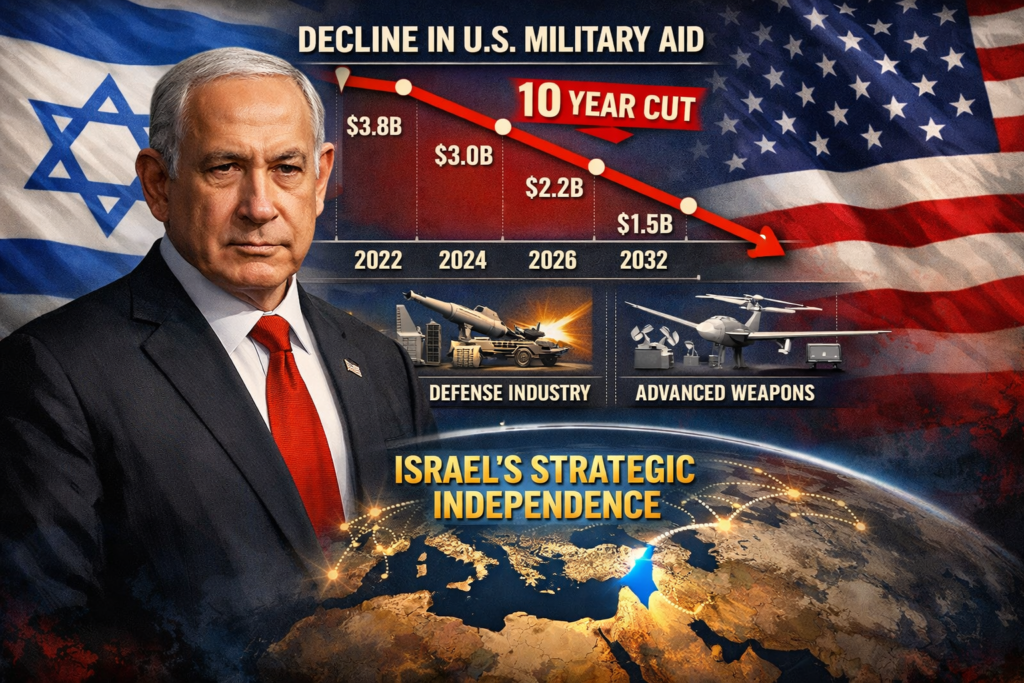
JERUSALEM — In a sweeping shift that could have far-reaching implications for global defense alliances and Middle Eastern geopolitics, Israeli Prime Minister Benjamin Netanyahu has publicly outlined an ambitious strategy to significantly reduce Israel’s reliance on United States military aid over the next decade. The proposal, discussed in a recent interview with The Economist, comes as Jerusalem seeks to redefine its defense capabilities and assert greater strategic independence amid evolving regional threats and international scrutiny. For decades, Israel has been one of the largest recipients of U.S. military assistance, receiving billions of dollars annually through longstanding defense agreements designed to bolster its security in a volatile region. But Netanyahu now argues that Israel has matured sufficiently — militarily, economically, and technologically — to chart a course toward self-reliant defense and reduced foreign dependency.
A Strategic Shift in Defense Policy
Netanyahu’s comments mark a public acknowledgment that Israel’s historic reliance on U.S. arms and financing may no longer be necessary at current levels. The existing military aid framework — a memorandum of understanding (MOU) signed in 2016 — commits Washington to provide approximately $3.8 billion annually through 2028, including grants for equipment purchases and missile defense programs. Speaking with The Economist, Netanyahu expressed deep appreciation for decades of American support but framed the proposed transition as a natural evolution for a nation that now boasts some of the most advanced defense technology on the planet. “We have come of age,” he said, emphasizing Israel’s growing self-sufficiency and expanding domestic defense industry.
The prime minister indicated that his goal is to taper military aid “down to zero” within ten years, though he stopped short of outlining a precise timeline for full independence. What is clear, however, is that the intention is to reduce predictable foreign assistance in favor of bolstering internal capability and global defense partnerships beyond the U.S. alliance.
Investing in Domestic Defense and Economic Growth
Central to Netanyahu’s vision is a massive investment in Israel’s own defense industry. The government has committed to pouring 350 billion shekels (approximately $110 billion) over the next decade into domestic arms production, including long-range missiles, autonomous systems, and advanced radar and defense technology.
This investment not only aims to lessen the need for imported weapons systems — many of which historically came from American manufacturers — but also to create a globally competitive defense sector capable of exporting to markets around the world. Already, Israeli defense exports have shown robust growth, with sales of cutting-edge multi-layered aerial defense systems rising in recent years.
Netanyahu cited accelerated innovation and technological breakthroughs as evidence that Israel’s armed forces — once dependent on external support — now stand on a foundation strong enough to sustain a future security posture with less foreign backing.
Political and Diplomatic Implications
Netanyahu’s announcement has sent ripples through political circles in both Israel and the United States. Within Israel, his comments come as the Likud party prepares for upcoming elections, giving the proposal a domestic political dimension: asserting strength, independence, and national self-confidence at a time when global scrutiny remains intense. In Washington, reactions are mixed. Some lawmakers express concern that phasing out U.S. aid too rapidly could destabilize Israel’s qualitative military edge in a region marked by ongoing tensions with Iran, Hezbollah, and other non-state actors. Others view the gesture as an opportunity for Washington to recalibrate its defense commitments and prioritize strategic cooperation rather than outright financial support. A leading U.S. senator recently argued that the U.S. might consider accelerated reductions in aid ahead of the decade-long timeline. Netanyahu has been careful to stress that the United States will remain a close defense partner, even as Israel seeks autonomy. He told The Economist that he will continue to “fight for the allegiance of the American people” and that political and military ties will endure even as financial dependence decreases.
Regional Context and Security Challenges
Israel’s decision to pursue military autonomy must be understood against the broader canvas of changing Middle Eastern security dynamics. Ongoing disputes with Iran, unresolved tensions with Hamas in Gaza, and shifting alliances with neighboring Gulf states all factor into Jerusalem’s defense calculations. An independent defense strategy, Netanyahu suggests, will allow Israel to act with greater flexibility and self-determination.
Critics warn that unilateral reduction of U.S. aid might weaken deterrence or embolden adversaries. They highlight the symbolic weight of U.S. support, which has often served as a stabilizing reassurance amid regional unpredictability. Analysts say that while greater self-reliance offers benefits, Israel’s security architecture may still require careful alignment with global partners, especially in areas like missile defense and intelligence sharing.
Economic Advantages and Public Opinion
Beyond security considerations, Netanyahu framed reduced foreign aid as a reflection of Israel’s economic ascent. Citing projections that Israel’s economy could approach a trillion-dollar valuation within a decade, he argued that domestic prosperity must translate into stronger national defense capabilities founded on local industry, talent, and innovation.
Public reaction in Israel has been varied. Some citizens welcome the notion of autonomy and self-sufficiency, seeing it as a natural next step for a nation that has weathered numerous conflicts and matured politically. Others remain cautious, preferring the security blanket that comes with American guarantees and concerned about what a funding withdrawal might mean during future crises.
A New Chapter in U.S.–Israel Relations?
Netanyahu’s proposal to taper off U.S. military aid within ten years represents a bold and historic pivot in one of the world’s most enduring strategic relationships. It carries implications not only for defense cooperation and regional power balances but also for diplomatic engagement and economic self-confidence. For now, it remains unclear how U.S. political leaders will respond, and what adjustments might emerge during the renegotiation of the current MOU when it expires in 2028. What is certain, however, is that Netanyahu’s remarks have opened a national conversation about Israel’s identity, capabilities, and future role on the global stage — one that few anticipated would take center stage so publicly.