From Presidential Palace to Brooklyn Detention Cell: Maduro’s Stark New Reality
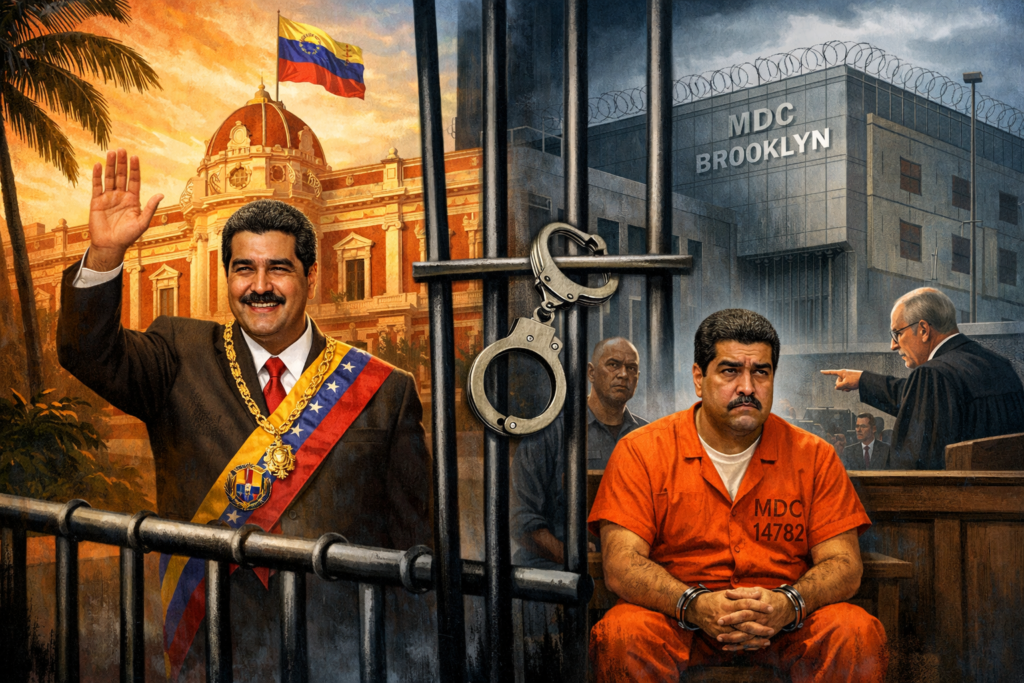
NEW YORK — Once the powerful president of an oil-rich nation, Nicolás Maduro now finds himself confined in one of the most notorious federal jails in the United States — a stark contrast to his opulent life in Venezuela’s Miraflores Palace. The dramatic shift in setting has drawn global attention, not just because of the unprecedented nature of a foreign leader standing trial in U.S. courts, but also due to the grim conditions he now faces in custody.
Maduro, 63, and his wife, Cilia Flores, were seized by U.S. forces in a nighttime operation in Caracas earlier this month and transported to New York to face federal charges, including narco-terrorism, cocaine trafficking and weapons offenses. The political significance of this prosecution — the first time a sitting state leader has been brought to U.S. soil under such charges — has made headlines worldwide.
But after the high-profile helicopter transfers and courtroom drama, Maduro now endures life behind bars in the gritty Metropolitan Detention Center (MDC) in Brooklyn — far from the luxurious settings he once commanded.
What MDC Brooklyn Is Really Like
The Metropolitan Detention Center, often referred to simply as MDC Brooklyn, is a federal jail facility located in the industrial neighborhood of Sunset Park in Brooklyn, New York. It is designed to hold pre-trial detainees — people awaiting court dates — and is known for housing notorious inmates with a wide range of high-profile cases.
Former warden Cameron Lindsay described the facility bluntly as “very stark and austere,” a place defined by strict routines, limited movement and an environment more reminiscent of a warehouse than anything luxurious. The conditions inside are a world apart from the leafy courtyards and ornate halls of Venezuela’s presidential palace.
Inmates at MDC Brooklyn face long hours in crowded and noisy quarters. According to legal analysts and attorneys familiar with the facility, the jail is dark, loud and often unpleasant, with limited access to outdoor space and strict schedules that govern every part of daily life.
Often, detainees in the facility’s Special Housing Unit (SHU) — where high-profile inmates like Maduro are likely kept for security reasons — are isolated from the general population and spend much of their day in small, confined spaces under strict supervision.
Conditions at MDC have long drawn criticism from former inmates, attorneys and lawmakers. The facility has been linked to overcrowding, violence, poor medical care and sanitation issues — concerns that have led some judges to resist sending defendants there. A 2025 fact sheet from the Bureau of Prisons itself acknowledged ongoing challenges, including lowered violence rates but continued lockdowns and limited recreation time for detainees.
Reports from past inmates have included allegations of botched medical treatment, vermin-infested food and frequent lockdowns, reflecting systemic issues that advocates say undermine basic standards of humane treatment.
Maduro’s Daily Routine Behind Bars
For Maduro, the fall from presidential power to federal detainee is symbolic. From the sprawling halls of Miraflores Palace — a seat of political authority with manicured grounds — he now navigates the rigid schedules and austere environment of MDC Brooklyn.
Sources familiar with federal detention practices say Maduro’s days likely begin early with count calls, followed by limited time out of his cell for showers, phone calls or legal meetings. Physical contact with other inmates is often curtailed for high-profile prisoners for security reasons, meaning he may spend many hours alone or only in the presence of guards or attorneys.
Attorney visits and communications with defense counsel are among the few breaks from confinement. On days when Maduro is transported for court appearances — as he was earlier this week — his movement is tightly controlled, often accompanied by armed escorts and strict security measures to prevent outside interference.
For many detainees, the mental strain of pre-trial detention — especially in a facility as infamous as MDC Brooklyn — is nearly as taxing as the physical environment itself. Attorneys familiar with MDC note that the lack of outdoor time, limited recreation and constant noise can wear down even the most disciplined individuals.
Maduro’s Courtroom Battles and Defense Strategy
Despite the bleak reality of jail life, Maduro’s legal team has focused on fighting the charges in federal court. In his first U.S. appearance, he pleaded not guilty to drug trafficking and narco-terrorism charges, asserting his innocence and claiming that he was “captured” unlawfully. His attorneys are expected to argue that Maduro should enjoy sovereign immunity as a head of state — a legal defense historically invoked in similar cases but rarely successful in U.S. courts.
Maduro also proclaimed himself “the president of my country” during the Manhattan arraignment, underscoring the political rather than purely judicial nature of the proceedings in the eyes of his defense. While acknowledging the indictment’s gravity, defense lawyers are preparing a series of legal challenges to question the legality of his capture and detention on U.S. soil.
The next major court date is set for March 17, 2026, giving both prosecution and defense months to prepare their arguments for a trial that could stretch into a complex and politically charged legal battle.
International Reaction and Geopolitical Fallout
Maduro’s detention in a U.S. jail has reverberated around the world. Governments such as Russia, China and Spain have criticized the U.S. operation, calling it a breach of international law and an affront to sovereignty. Meanwhile, protests in cities around the world — from Caracas to New York — have drawn both supporters and detractors of the U.S. action.
In Venezuela, interim leaders appointed after Maduro’s removal have denounced the operation, insisting that Maduro remains the legitimate president and that his absence is a violation of international norms. Supporters of Maduro have used his incarceration as a rallying point against foreign intervention.
The U.S. government, for its part, continues to frame the prosecution as a necessary law-enforcement action based on serious criminal charges that have accumulated over years of investigation. This stance has drawn both praise and criticism from lawmakers and legal experts in the United States.
Human Story Behind the Headlines
Beyond the geopolitics and legal maneuverings, Maduro’s confinement in one of America’s toughest detention centers is emblematic of a broader narrative: the collision of power, accountability and individual fate. The once-respected hallways of political authority have given way to institutional corridors where detainees endure stark routines, limited freedoms and the harsh reality of federal incarceration.
For many observers, his situation raises questions about how justice and power converge — and whether the U.S. model of detention upholds the human dignity that democratic systems aspire to protect. In a place where overcrowding and systemic issues have long drawn criticism, the treatment of a former head of state adds a layer of scrutiny and reflection on what justice means in a global context.