Trump Administration Freezes Social Safety Net Funding for Five States, Citing Fraud Concerns and Triggering Deep Political Backlash
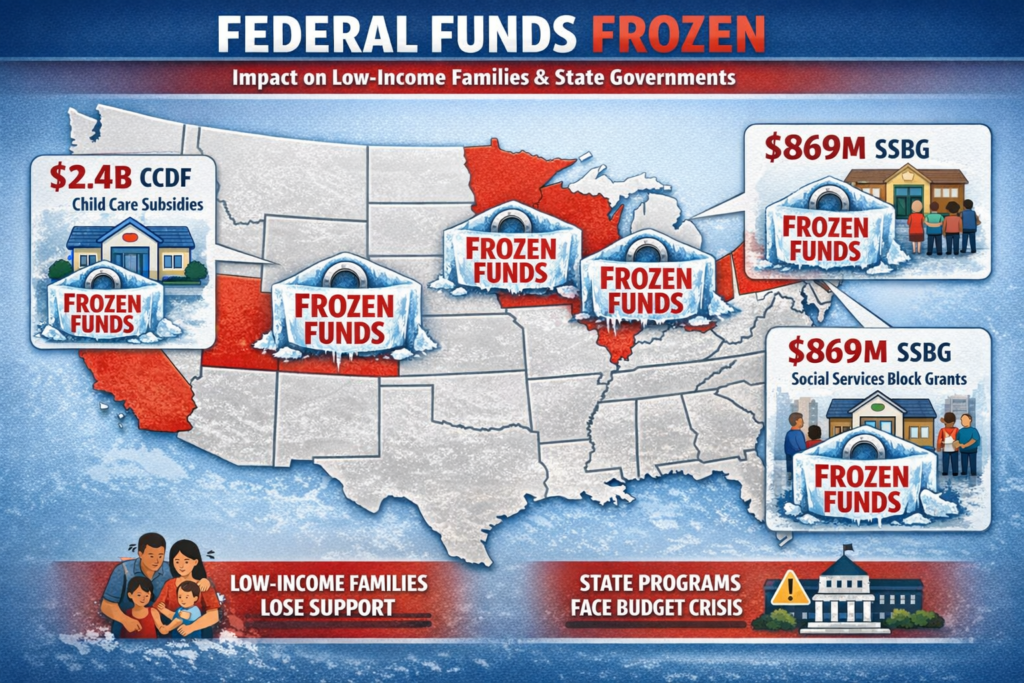
WASHINGTON, D.C. — The Biden-era safety net that supports millions of American families is now at the center of a heated political controversy after the Trump administration announced it is withholding more than $10 billion in federal funding from five predominantly Democratic states, citing alleged fraud in social service programs.
The decision — which affects critically important federal resources used for child care, cash assistance and other services for low-income families — has prompted rare bipartisan criticism over both its timing and its potential impact on vulnerable populations. State officials have blasted the move as politically motivated, while federal officials argue it is necessary to maintain the integrity of taxpayer-funded programs.
This major funding freeze touches on some of the country’s most visible social safety net programs, and the ripple effects are expected to reverberate through communities across the affected states.
What Programs Are Affected and How Much Money Is on Hold
The Department of Health and Human Services (HHS) — which administers many federal social service grants — has moved to withhold funds tied to three major programs that provide essential support to families in need:
- Child Care and Development Fund (CCDF) — more than $2.4 billion in subsidies that help low- and moderate-income parents afford child care while working or attending school.
- Temporary Assistance for Needy Families (TANF) — roughly $7.35 billion in cash assistance and job training funds for families with children living in poverty.
- Social Services Block Grant — about $869 million for a range of local social services including food assistance, utility help and crisis intervention.
In total, the funds on hold exceed $10 billion, representing a significant portion of the federal safety net that states count on to run programs for low-income residents.
The states targeted by the freeze are California, Colorado, Illinois, Minnesota and New York — all led by Democratic governors.
Administration’s Rationale: Fraud and Improper Benefit Use Allegations
According to HHS officials, the freeze reflects the administration’s concern that federal benefits may have been improperly disbursed to individuals who are not legally eligible, including people without lawful resident status in the U.S. HHS spokesman Andrew Nixon framed the move as necessary to protect taxpayer dollars and to ensure accountability in the application of safety net funds.
“No state will receive certain child care, cash assistance and social service funds until they provide comprehensive documentation verifying that these benefits are being used lawfully and for intended purposes,” Nixon said, without presenting specific evidence publicly.
In Minnesota, this trend began late last month when federal officials paused all child care funding in that state amid an ongoing federal investigation into alleged fraud in day care programs. This included scrutiny of centers reportedly billing for services that did not occur.
The Trump administration has also extended its review to administrative funds for programs like SNAP, the nation’s primary food assistance program, requiring states to submit additional data on recipients before accessing dollars that allow states to administer the benefit itself.
However, critics argue that the administration has so far provided no detailed data or independent audit findings to substantiate its sweeping assertions of widespread fraud across multiple programs, leading to accusations that the policy is politically driven.
💥 State and Political Response: Accusations of Retaliation and Harm
Democratic leaders in the affected states responded with swift and sharp criticism, calling the freeze a punitive measure that will directly harm children and families who rely on these services to make ends meet.
California Governor Gavin Newsom condemned the move as “vindictive” and lacking transparency, saying the state has its own procedures to combat fraud and that federal accusations miss the mark. New York Governor Kathy Hochul declared her intent to pursue legal action, arguing that “kids should not be political pawns” in a dispute between state and federal governments.
Colorado officials said cutting off essential support is “immoral” and could have devastating effects on working families, especially those already struggling with soaring child-care costs and economic uncertainty.
Illinois and Minnesota leaders also condemned the decision, with Minnesota pointing out that local law enforcement and state auditors have been investigating fraud independently — even before the federal scrutiny — and challenging the idea that malpractice is endemic to their programs.
🏛️ Political Implications and Broader Debate
Many observers see the funding freeze as part of a wider pattern in which the Trump administration increasingly uses federal spending power as leverage in political disputes with Democratic-led states. Critics say this tactic weakens cooperative federalism — the idea that state and federal governments work together to deliver public services — and risks undermining essential programs that millions of Americans depend on.
Republican supporters of the freeze insist that fiscal accountability and fraud prevention are legitimate priorities, and that requiring stronger documentation from states will help safeguard public funds. But opponents argue that the processes in place already include robust audits and enforcement mechanisms, making broad freezes unnecessary and potentially harmful.
The controversy follows previous clashes over immigration, pandemic relief spending and other federal programs, and many analysts warn that the current dispute could presage future budget battles if better-off states continue to resist federal requirements they see as punitive or opaque.
Some commentators argue that the freeze could pressure states into adopting more stringent fraud controls in social programs. Others warn that the timing — just after a federal election cycle and in a politically charged environment — suggests motivations other than simply protecting taxpayer money.
📊 Economic and Human Impact: Who Pays the Price?
On the ground, the freeze is expected to hit the most vulnerable populations first — particularly low-income families with children who rely on subsidized day care, cash assistance and social services to stay afloat.
Child care providers are already bracing for payment delays that could force layoffs and closures, especially in communities where federal subsidies are a major source of operating revenue. Parents who depend on child care assistance to work or attend school fear losing access to affordable care, which could jeopardize employment and income.
Temporary Assistance for Needy Families (TANF) helps millions of families with essential needs like food, clothing and shelter. A freeze on TANF dollars could compound existing hardships, economists warn, particularly as inflation and housing costs remain high in many parts of the United States.
Social Services Block Grant funds, while smaller in scale, support a range of local programs including food assistance, utilities help and crisis support. Cutting off these funds could force counties and municipalities to reduce services or find alternative — and often more expensive — funding sources.
Nonprofit advocates and human-rights organizations have already expressed concern that the freeze could reverse years of progress in addressing child poverty and inequality, urging federal and state leaders to find common ground before essential services are disrupted.
🧭 What Happens Next? Legal Battles and Extended Review
State officials in California, New York, Colorado, Illinois and Minnesota have signaled plans to challenge the funding freeze in court, alleging that due process has been violated and that federal law does not allow for arbitrary withholding of funds without clear evidence and procedural safeguards.
Several governors and lawmakers say they are preparing legal complaints alleging that the federal government is overstepping its authority and jeopardizing public welfare for political reasons. These lawsuits could take weeks — if not months — to resolve, potentially leaving families in limbo as programs struggle to stay afloat without federal support.
Meanwhile, HHS officials say they will continue reviewing documentation provided by states and that frozen funds may be restored once the agency is satisfied that fraud controls and verification processes are in place. But details about what qualifies as acceptable documentation remain unclear and subject to ongoing negotiation — meaning the freeze could extend into the spring or beyond.