NASA’s MAVEN Mars Orbiter Falls Silent, Scientists Scramble to Restore Contact
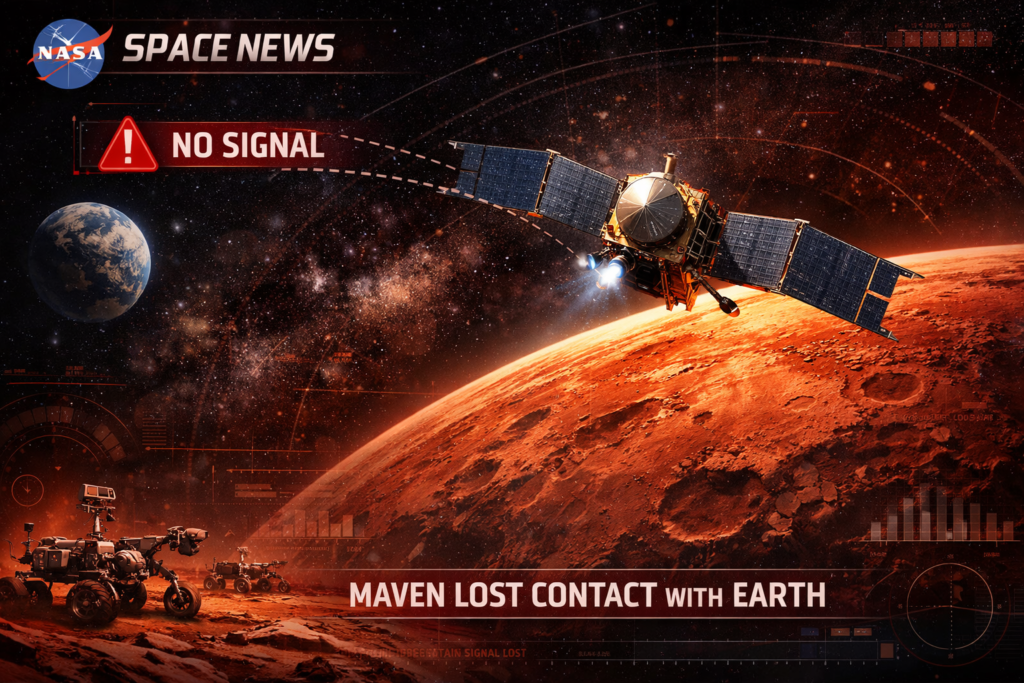
WASHINGTON, D.C. — NASA officials are working urgently to re-establish communication with the MAVEN spacecraft, a long-serving orbiter that has been circling Mars since 2014 after unexpectedly falling silent earlier this month.
MAVEN — which stands for Mars Atmosphere and Volatile EvolutioN — stopped transmitting data to Earth on Dec. 6, 2025, shortly after emerging from behind the Red Planet during a routine orbit. Ground teams had expected its signal to return once it passed out of Mars’ radio shadow, but instead communication never resumed, leaving engineers without telemetry from the probe.
Prior to the loss of contact, MAVEN’s telemetry showed all onboard systems operating normally. However, a small fragment of tracking data suggests that the spacecraft was rotating in an unexpected way when it reappeared, and that its orbital path may have shifted, which could complicate efforts to restore two-way communication.
Launched in November 2013 and reaching Mars nearly a year later, MAVEN has spent more than a decade studying the planet’s upper atmosphere, helping scientists understand how the Sun’s solar wind may have stripped Mars of much of its once-thicker air. The mission has also acted as a key communications relay for surface rovers like Perseverance and Curiosity.
“We continue listening for signals and analyzing tracking data,” NASA said in a recent update, acknowledging the challenge of pinpointing the anomaly but emphasizing that efforts are ongoing. Engineers are exploring every potential explanation — from sensor malfunctions to unexpected rotational dynamics — as they work to revive the spacecraft.
NASA has other orbiters still actively circling Mars, including the Mars Reconnaissance Orbiter and Mars Odyssey, ensuring continued support for robotic explorers on the planet’s surface. Yet the silence from MAVEN — one of the most productive scientific missions at Mars — underscores the risks of long-duration space operations in remote, harsh environments.
For now, mission teams remain hopeful that contact can be restored and that NASA’s long-aerial Mars scientist may yet return to productive service.