Iowa Senate Special Election Could Restore GOP Supermajority as Voters Head to Polls
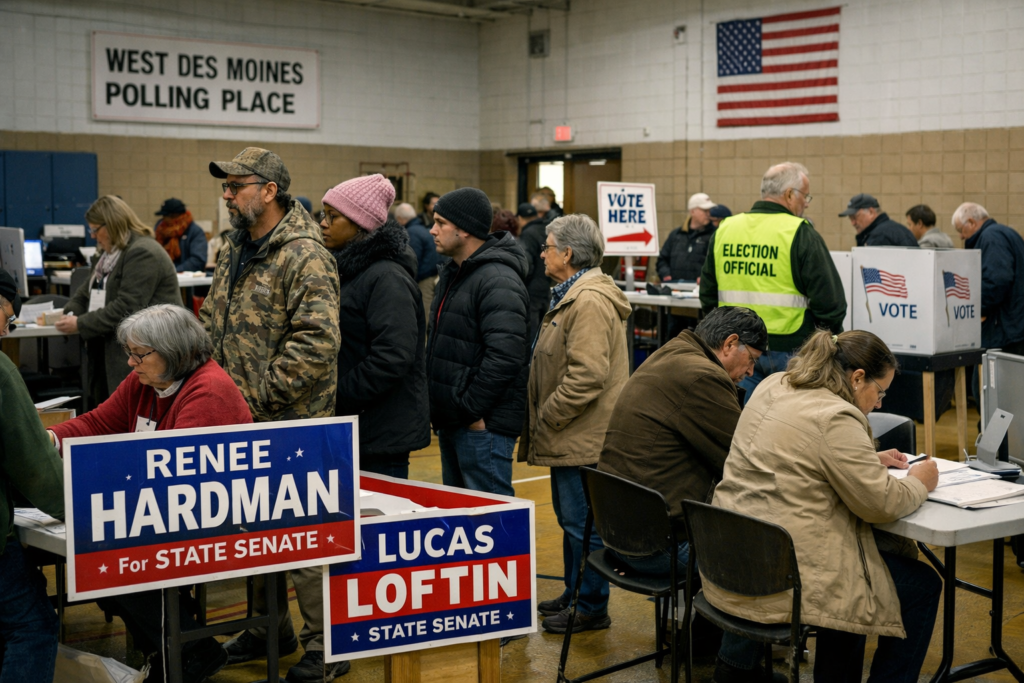
DES MOINES, Iowa — Voters in a key Iowa state Senate district are heading to the polls this week for a year-end special election that could give Republicans back their supermajority in the chamber, a strategic prize that would significantly enhance the party’s legislative power in the 2026 session. The contest is being closely watched by political operatives and analysts as a gauge of party strength in a state that has become a national battleground.
The special election stems from the October death of Democratic state Sen. Claire Celsi, who represented the 16th Senate District — covering parts of West Des Moines, Windsor Heights and Clive — and leaves an open seat that could change the balance of power.
On Tuesday, Republican Lucas Loftin — a data and software professional with roots in environmental services — faces Democrat Renee Hardman, a West Des Moines city council member and nonprofit CEO, in a head-to-head race. Loftin’s victory would push Republicans back to a two-thirds supermajority, restoring a level of control that allows the GOP to pass certain measures, confirm gubernatorial appointments and override vetoes without needing Democratic support.
Currently, Republicans hold 33 seats to the Democrats’ 16 in the 50-member Iowa Senate, one short of the 34 seats needed for the supermajority. A win in this contest would re-establish full GOP legislative command after Democrats broke that dominance earlier in 2025 by flipping a Republican-held seat in a special election in Sioux City, a district carried by former President Donald Trump last year.
That August special election win by Democrat Catelin Drey not only delivered a victory in a traditionally Republican area, it also ended the GOP’s two-thirds control of the chamber, forcing Iowa Republicans to negotiate with at least one Democrat on critical matters such as confirming Governor Kim Reynolds’ appointments.
Backers of both parties have poured time and money into the campaign, each framing the election as a referendum on Iowa’s priorities ahead of the 2026 midterms. Hardman’s campaign emphasises issues such as affordable housing, childcare, healthcare and government transparency. Loftin’s campaign has spotlighted conservative priorities including tax reform and school and family policies.
Political observers say the outcome could reverberate beyond Iowa, offering early signals of voter sentiment in Midwestern states where control of state legislatures shapes everything from redistricting to education and healthcare policy in coming years.