NASA Gears Up for Historic Artemis II Mission: Astronauts to Fly Around the Moon in 2026
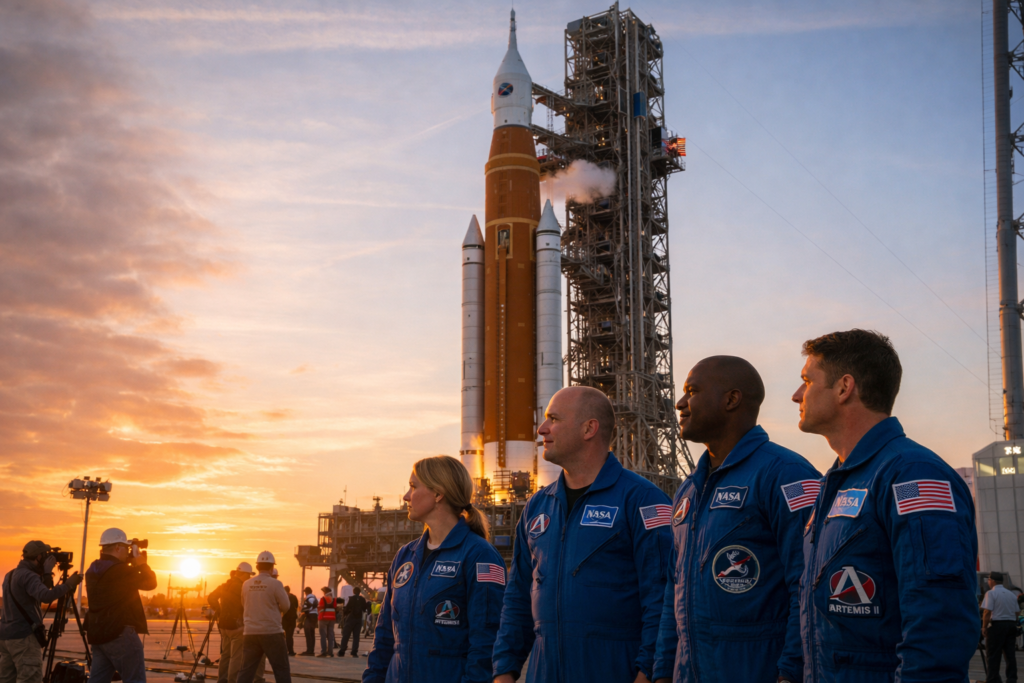
WASHINGTON, D.C. — NASA is preparing for a major milestone in space exploration as the Artemis II mission, scheduled to launch in early 2026, will send four astronauts on a 10-day journey around the Moon and back — the first crewed flight beyond Earth’s orbit in more than half a century. This pivotal mission represents a key step in NASA’s broader efforts to establish a long-term human presence on the Moon and lay the groundwork for future missions to Mars.
Set to blast off no later than April 2026 from NASA’s Kennedy Space Center in Florida, Artemis II will carry astronauts Reid Wiseman, Victor Glover, Christina Koch and Canadian Space Agency astronaut Jeremy Hansen aboard the Orion spacecraft, atop NASA’s powerful Space Launch System (SLS) rocket. The crew will test Orion’s systems under real deep-space conditions and perform critical maneuvers necessary for future lunar expeditions.
The mission’s flight plan calls for a trans-lunar injection burn that sends Orion out of Earth orbit toward the Moon. Astronauts will journey roughly 4,600 miles beyond the lunar far side, traveling in a figure-eight pattern that uses the Moon’s gravity to sling the spacecraft back toward Earth. While the crew won’t land on the lunar surface, this flyby will mark humanity’s closest return to lunar exploration since NASA’s Apollo missions ended in 1972.
In addition to testing spacecraft navigation and life-support systems, Apollo II will carry scientific payloads designed to monitor space radiation, communications, and the effects of deep-space travel on human health — data that will prove invaluable for future long-duration missions.
The Artemis program’s goals extend beyond exploring the Moon. NASA officials say Artemis II will serve as a foundation for Artemis III and later missions, which aim to land astronauts — including the first woman and next American — on the lunar surface. These missions are seen as precursors to humanity’s eventual journey to Mars.
NASA has also launched public engagement efforts that invite people around the world to “send their name” aboard Artemis II, offering digital boarding passes for participants who sign up online.
As the launch date nears, crews and engineers continue rigorous training and preparation, refining every detail to ensure safety and mission success. The Artemis II mission symbolizes a new era of human spaceflight — one that honors the legacy of Apollo while pushing the boundaries of what’s possible in space exploration.