Power, Pride and Pressure in Venezuela: Delcy Rodríguez, Maduro’s Legacy and Trump’s Controversial Comments on Leadership and Control
CARACAS / WASHINGTON — What does it mean for a nation when its leadership is contested, its future uncertain and its people caught in the middle of global headline news?
That’s the question now playing out on the international stage with Venezuela — a country rich in oil, steeped in history, and recently thrust into the middle of one of the boldest geopolitical actions of the year. After the U.S. military captured Venezuelan President Nicolás Maduro in early January, a dramatic power struggle has unfolded, drawing Washington and Caracas into a complex and emotionally charged fight over legitimacy, sovereignty, and the future of more than 30 million Venezuelans.
At the center of this story is Delcy Rodríguez, the former vice president of Venezuela who has assumed the role of interim president — and whose status is now a fulcrum of international controversy.
The Aftermath of Maduro’s Capture
On January 3, 2026, U.S. forces executed a surprise strike in Caracas that resulted in the capture of Nicolás Maduro and his wife, Cilia Flores, who were immediately flown to New York to face federal charges, including narcotics and terrorism-related accusations.
Maduro, shackled in a Brooklyn courtroom, declared through a translator that he remained president of Venezuela even as he fought the charges against him. “I am innocent … I am still president of my country,” he told the judge, a moment that highlighted both the legal battle now underway and the political storm brewing far beyond the courtroom doors.
Meanwhile, back in Caracas, Venezuela’s Supreme Court and the military recognized Delcy Rodríguez as acting president, enshrining her authority under the country’s constitution following Maduro’s abrupt removal.
Trump’s Controversial Take on Venezuela’s Leadership
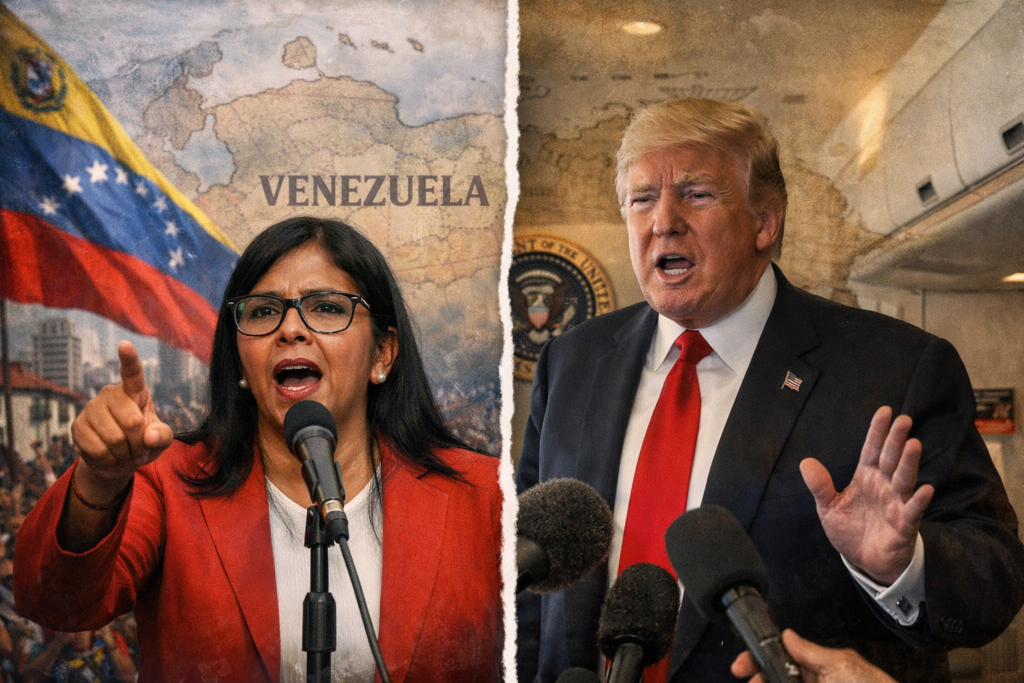
From Washington, President Donald Trump has made headlines by publicly staking out an unusually assertive position on Venezuela’s leadership — suggesting that the United States is effectively “in charge” of the country following Maduro’s capture. Multiple Trump statements, including a press briefing and interviews with American media outlets, drove home a message that blurred lines between diplomatic cooperation and direct influence, with Trump saying, “We’re going to run the country until such time as we can do a safe, proper and judicious transition.”
Trump’s words have been met with strong reactions from around the world. In Washington, some Republicans framed this stance as a necessary and pragmatic approach to stabilize Venezuela, protect oil interests, and prevent chaos. But critics — including international observers and many Venezuelans — see the comments as a stark assertion of power that ignores the nation’s sovereignty and the will of its people.
Delcy Rodríguez — A Leader Under Fire
Delcy Rodríguez’s role — both as interim leader and as a figure willing to navigate this fraught political terrain — is complicated. While the Supreme Court and military forces in Caracas have declared her acting president, Rodríguez herself has issued strong public statements insisting that Maduro remains the legitimate president and that Venezuela will never submit to foreign control, even as she extends an olive branch on cooperation with the United States.
In televised addresses and statements, Rodríguez has emphasized Venezuelan sovereignty, calling for calm and unity among her people while resisting any notion that a foreign power is running the country. “There is only one president in this country, and his name is Nicolás Maduro,” she said in a public broadcast soon after the U.S. operation.
At the same time, Rodríguez has also expressed willingness to explore “balanced and respectful cooperation” with the United States, emphasizing mutual development and peace, even as she rejects Washington’s narrative. This shifting tone reflects not only political pressure but a deep emotional complexity within Venezuela itself — a country striving to reconcile its identity, its leadership, and its future.
Legitimacy and Identity in a Nation in Flux
For many Venezuelans, the situation is deeply personal. Maduro loyalists view Rodríguez’s rise not as legitimate but as forced by external action, while opponents of the former president see an opportunity for a new chapter. Opposition leader María Corina Machado, for example, has been suggested by some analysts as a future contender for leadership, challenging the idea that the interim government alone should define Venezuela’s path forward.
Every day, ordinary families — parents, students, workers — discuss the news of new oil policies, U.S. involvement and international relationships with a mix of fear, hope, skepticism, and longing for stability. For many Venezuelans who have watched inflation, shortages, and political tension take decades off life expectancy and wellbeing, the question of who leads their country is more than political theory — it’s deeply personal and deeply real.
What’s Next: Politics, Diplomacy and Hearts Back Home
The international community remains divided. Some nations condemn the U.S. military action as a violation of Venezuelan sovereignty, while others celebrate the opportunity for reform and peace. The United Nations and regional powers have called for calm, while voices in both the U.S. and Venezuela continue to argue over what should come next.
In Washington, Trump’s focus has been clear: stabilize the nation, secure access to Venezuelan oil as part of new diplomatic and economic strategies, and reshape the country’s political landscape in a way he considers beneficial for both Venezuelans and U.S. interests.
But in Caracas — a city marked by resilience and complexity — many ordinary citizens are left wondering who truly represents them, who holds legitimacy in a time of dramatic upheaval, and what it means to be a nation with its soul under deep scrutiny.