Eddie Bauer’s Chapter 11 Filing: Iconic Outdoor Retailer Faces Hard Road as Stores Seek Buyer or Prepare to Close
For millions of Americans who grew up exploring forests, lakes and mountain trails, Eddie Bauer isn’t just another brand — it’s a piece of outdoor history. From the down-filled jackets that kept adventurers warm on frigid mountaintops to the cozy flannels worn on weekend camping trips, the company became a staple of American outdoor life. But now, in a painful chapter for fans and employees alike, the retail operator of Eddie Bauer stores across the United States and Canada has filed for Chapter 11 bankruptcy protection.
The announcement came on February 9, 2026, when Eddie Bauer LLC — the entity that runs roughly 180 retail and outlet stores — filed legal paperwork in the U.S. Bankruptcy Court for the District of New Jersey. The company said it has entered a restructuring agreement with its secured lenders and is beginning a court-supervised sales process. If a buyer cannot be found, a wind-down of North American operations may follow.
This is a deeply emotional moment for staff, longtime customers, and outdoor enthusiasts who watched the brand’s fortunes rise and fall over more than a century. But it also reflects a larger shift in how Americans shop and how legacy brands must evolve in a rapidly changing retail landscape.
A Century-Old Story Under Strain
Eddie Bauer’s history reads like the story of American adventure itself. The company began in 1920 in Seattle as Bauer’s Sports Shop, founded by an avid outdoorsman whose vision was to create dependable gear for people who lived to explore. Over the decades, the brand pioneered innovations such as the patented down jacket and outfitted some of America’s boldest explorers, including the first American to reach the summit of Mount Everest.
But today’s filing marks the third time the company has sought bankruptcy protection, a sobering reminder of how even beloved brands can struggle to adapt to shifts in consumer habits and competition from niche outdoor labels.
At its peak, Eddie Bauer operated close to 600 stores across the U.S., Canada and beyond. Over the years, however, sales declined as shoppers increasingly turned to online giants and trend-focused competitors like Fjällräven and Arc’teryx. Higher costs, inflation, supply chain disruptions and uncertain tariff policies also compounded the brand’s challenges in recent years.
What the Bankruptcy Means for Stores and Shoppers
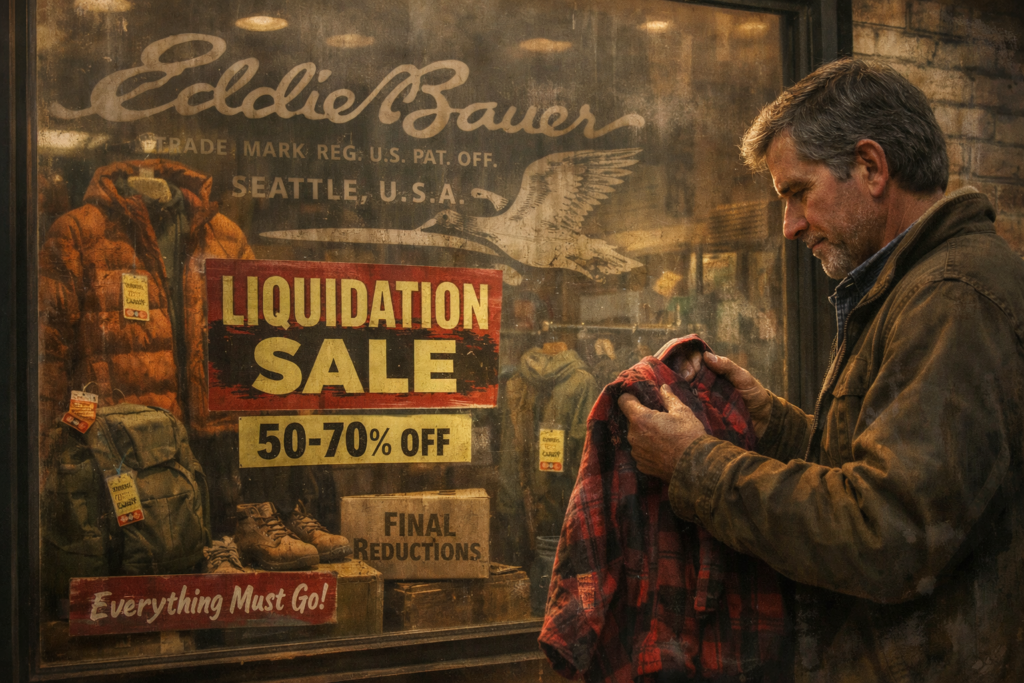
While the Chapter 11 filing doesn’t mean immediate store closures, it does mean change is coming — and likely soon. Eddie Bauer will begin liquidation sales at its roughly 180 North American retail and outlet locations as it searches for a potential buyer interested in taking over the business.
Customers in cities from Seattle to Boston are already seeing mark-downs on outdoor jackets, boots, camping gear and winter sweaters — many of which carry memories of family vacations and heated campfire stories. But behind those sales are real worries: employees wondering about their jobs, local mall goers losing familiar storefronts, and loyal shoppers fearing an end to the hands-on experience of trying on gear in person.
If a buyer cannot be found by mid-March 2026 — the court’s deadline — the company may begin a full wind-down of its brick-and-mortar presence in the U.S. and Canada, leaving many long-time fans lamenting what once was.
What Survives — And What Doesn’t
Importantly, the bankruptcy filing only affects the retail arm that runs physical stores. Eddie Bauer’s e-commerce, wholesale operations and international outlets are not part of this filing. Those parts of the business are operated under separate licenses — in part by a company called Outdoor 5, LLC — and will continue without interruption.
The brand’s intellectual property — its name, logo and core identity — is owned by Authentic Brands Group, which may choose to license the label to other operators or invest further in digital expansion.
That means you might still find Eddie Bauer gear in online shops or in wholesale outlets even if mall stores close. But for those who grew up visiting flagship locations to feel the fabric of a winter coat before a family ski trip, that’s a bittersweet reality.
Voices from Inside and Out
The emotional toll of this announcement has rippled across social media and local communities. In Reddit comments and customer forums, fans of the brand are sharing memories of their first Eddie Bauer jacket, the flannel shirts that lasted for decades, and stories of sales rack treasures found at local outlets. For many, it’s more than commerce — it’s the soundtrack of family hikes, school trips and quiet mornings watching the sunrise at a campsite.
Employees, meanwhile, are bracing for uncertainty. Staff members in Colorado, North Carolina and elsewhere have already seen closures and reduced inventory in recent months as liquidation sales began. One longtime employee shared how closing a local store felt like saying goodbye to a second home — a sentiment echoed by loyal customers who grew up with the brand.
A Reflection of Changing Times
Eddie Bauer’s bankruptcy is part of a broader trend affecting legacy retailers in the U.S. This year alone, many traditional brick-and-mortar brands — long anchored in malls and shopping districts — have announced closures or restructuring plans, squeezed by online competition, shifting consumer tastes, and the continuing evolution of the retail economy.
For some shoppers, the rise of direct-to-consumer brands and digitally native companies has offered fresh alternatives. But for others, seeing a century-old brand struggle is a stark reminder that nostalgia and legacy can’t always shield a company from the realities of modern markets.
What Comes Next
As court-supervised proceedings continue, Eddie Bauer’s future hangs in the balance. A sale to a new buyer could mean a rebirth — perhaps smaller, perhaps more digitally focused, but still alive. If no buyer steps forward, many North American stores could close by mid-2026, ending an era in American outdoor retail.
For now, liquidation sales continue, customers sift through deeply discounted jackets and gear, and loyal fans watch with heavy hearts as an iconic American brand navigates one of its toughest seasons yet.