World Enters Uncharted Nuclear Era as New START Treaty Expires — Risks of Renewed Arms Race Rise
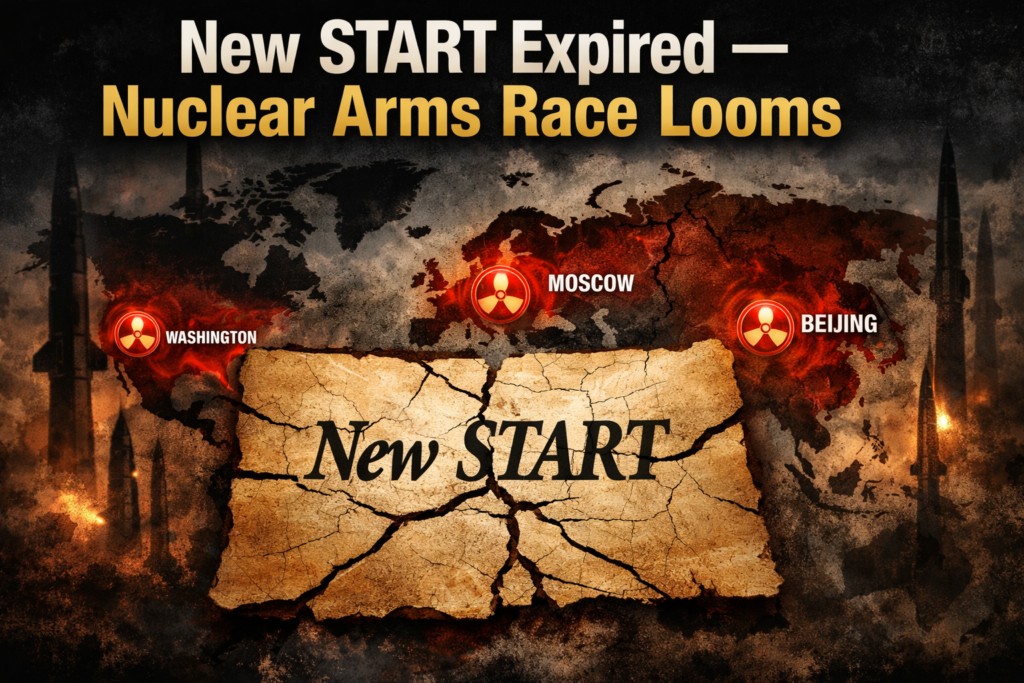
WASHINGTON, D.C. — For the first time in over 50 years, the United States and Russia are no longer bound by a major treaty limiting their nuclear arsenals, ushering in a period of heightened global uncertainty and potential nuclear arms competition among major powers including China. On Feb. 5, 2026, the New Strategic Arms Reduction Treaty (New START) officially expired — ending the last meaningful constraint on the world’s two largest nuclear stockpiles and opening the door to what many experts warn could become a new nuclear arms race.
Signed in 2010 by U.S. President Barack Obama and Russian President Dmitry Medvedev, New START limited each side to no more than 1,550 deployed nuclear warheads and about 700 delivery systems, such as intercontinental ballistic missiles and strategic bombers. The treaty also established verification protections, including on-site inspections and data exchanges that helped reduce mistrust between the two powers for more than a decade.
But with nothing in place to replace it, the strategic landscape is shifting under rising geopolitical tensions — adding pressure not just on Washington and Moscow, but on Beijing as well.
How New START Worked — and What Its End Means
For decades, New START served as the cornerstone of nuclear arms control, building on earlier Cold War agreements and mutual limitations aimed at reducing the risk of accidental conflict and unrestrained weapons buildups. By capping the number of deployed strategic warheads and delivery systems and requiring data exchange and inspections, it helped keep radical expansions of nuclear capabilities in check.
Yet even before its expiry, key elements of the treaty had eroded. Russia formally suspended participation in February 2023, halting nearly all inspections and data exchanges while still pledging to respect warhead limits. Washington responded in kind, effectively freezing verification mechanisms years before the treaty’s legal endpoint.
With the February 5 expiration, both countries are now legally free to expand their strategic nuclear forces without formal caps — a dramatic reversal of decades of controlled nuclear competition. Analysts warn this could remove a critical layer of predictability and caution from great-power relations.
U.S. Position: Trump Administration and Nuclear Policy
The treaty’s expiration took place under the administration of former President Donald Trump, who expressed mixed views on New START’s renewal. While Trump acknowledged concerns about the collapse of nuclear limitations, he resisted a straightforward extension without securing broader participation — particularly from China, whose rapidly growing arsenal was not covered under New START.
Trump’s critics argue the administration failed to pursue a feasible successor framework or to de-escalate strategic competition, instead leaving U.S. and Russian arsenals unconstrained. Supporters of the lapse counter that without China’s inclusion and updated verification measures, continuing an outdated pact was illogical.
Russia’s Reaction and Strategic Signaling
Russian President Vladimir Putin expressed regret over the treaty’s expiration but underscored that Moscow no longer felt bound by its provisions unless Washington agreed to mutual limits. While Russia suggested it would abide by the treaty’s core numerical restrictions for a time, Kremlin officials refrained from legally binding commitments once the pact officially expired.
The Kremlin also flagged that both sides are now free to choose future strategic postures without the constraints of treaty verification — a move that could encourage further modernization of nuclear delivery systems and tactical weapons.
China’s Role: A Different Nuclear Dynamic
Unlike the U.S. and Russia, China was never a party to New START, and its smaller but rapidly expanding nuclear arsenal remained outside the treaty’s reach. Following the expiration, Beijing publicly called the lapse “regrettable” and urged both Washington and Moscow to resume meaningful negotiations on nuclear stability.
Chinese officials have emphasized a commitment to a minimal deterrent and “no first use” policy, distinguishing their nuclear posture from the superpowers’ large strategic stockpiles. But China’s growing arsenal — which experts believe is on course to rival older Cold War inventories in coming decades — adds complexity to future arms control efforts.
Global Security Implications: New Arms Race Fears
The expiration of New START has reignited widespread fears of a renewed arms race. With key verification measures defunct and no successor agreement in place, experts warn that mistrust between nuclear powers could increase, particularly amid geopolitical flashpoints such as the ongoing war in Ukraine and tensions in the Indo-Pacific.
United Nations Secretary-General António Guterres called the treaty’s end a “grave moment” for international peace and security, urging a return to negotiations and a new framework that could reduce nuclear risks rather than inflame them.
Analysts caution that the lack of constraints could not only lead to expansions in strategic nuclear stockpiles but also undermine broader arms control mechanisms, including the Nuclear Non-Proliferation Treaty (NPT), a global pact aimed at limiting the spread of nuclear weapons and encouraging disarmament.
The Strategic Landscape Beyond New START
With New START no longer in force, the nuclear balance now hinges on a mix of national strategies, military priorities and geopolitical competition. All three nuclear powers — the United States, Russia and China — are continuing to invest in modernization of their nuclear forces, exploring advanced delivery systems, and in some cases increasing stockpiles and capabilities.
Some experts believe that in the absence of formal binding limits, nuclear arsenals may grow “on paper” as nations hedge against perceived threats, fueling instability. Others suggest that informal understandings, military restraint and diplomatic engagement could still slow competitive buildups — though without verifiable treaties, those are inherently fragile.
What’s at Stake for the World
For the American public — and the global audience concerned about existential threats — the end of New START represents more than a diplomatic technicality. It dismantles a long-standing structure of nuclear risk management and places greater emphasis on diplomatic leadership, transparency and nuclear risk reduction initiatives if another arms race is to be avoided.
Observers warn that the lack of formal constraints could increase the likelihood of nuclear proliferation, miscalculation, and strategic instability, making the geopolitical landscape more unpredictable than it has been since the height of the Cold War.
Yet there remains a window of opportunity for renewed dialogue — whether through traditional bilateral frameworks or expanded multilateral talks that include China and other nuclear powers. The next chapter of global nuclear policy will likely be shaped by whether governments choose to pursue cooperation, competition or a tenuous balance between the two.