U.S. Jobs Report: 64,000 Jobs Added in November but 105,000 Lost in October — Unemployment Hits 4.6% Amid Slow Labor Market
WASHINGTON — The latest final U.S. jobs report for November and October 2025 revealed a mixed labor market picture, with modest hiring in November countered by significant job losses in October and a rising unemployment rate, according to data released Tuesday.
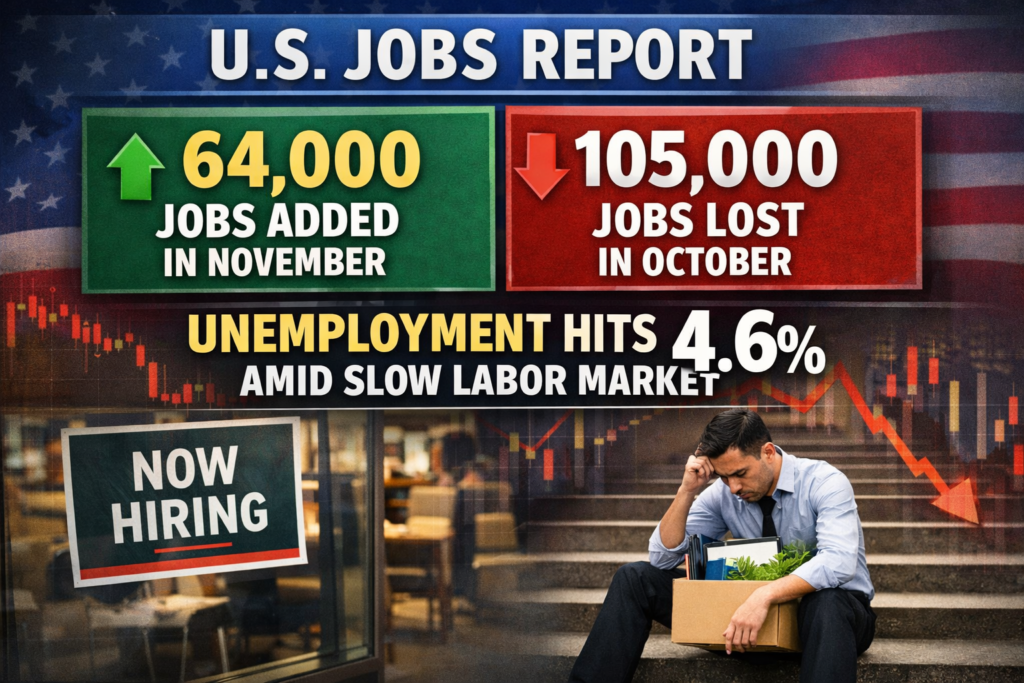
November Job Gains and Weak Overall Growth
In November 2025, the U.S. economy added 64,000 jobs, exceeding economists’ forecast of roughly 40,000 and offering a sign of modest labor market resilience.
However, that positive news was largely overshadowed by October’s loss of 105,000 jobs, driven largely by a sharp drop in federal government employment following workforce reductions and delayed reporting caused by a 43-day federal government shutdown.
Unemployment Rate Rises to Highest in Four Years
The combined employment report also showed that the **U.S. unemployment rate climbed to 4.6% in November — the highest level since 2021.
Economists say this increase signals slowing hiring momentum across the U.S. labor market, as employers remain cautious amid economic uncertainty, rising costs, and policy shifts.
Delayed Data and Government Shutdown Effects
The release of this combined jobs report came weeks late due to the prolonged government shutdown, which disrupted data collection and forced the Bureau of Labor Statistics (BLS) to merge October statistics with November’s employment report.
Because of the shutdown, some components — including detailed household survey data for October — could not be calculated on time, complicating analysts’ ability to fully assess month-to-month trends.
Sector-Specific Trends
November’s job gains were concentrated in sectors such as health care and construction, which added thousands of positions, while manufacturing and federal government payrolls continued to contract.
The private sector led job growth, but hiring was described by economists as moderate at best, with many businesses hesitant to expand payrolls amid economic headwinds.
Economic Implications and Federal Reserve Outlook
The slower pace of job growth and rising unemployment add to growing concerns about the strength of the U.S. labor market as the economy enters 2026. Analysts suggest the labor report could influence Federal Reserve decisions on future interest rate adjustments, particularly because the job market figures appear weaker than expected.
Federal Reserve Chair Jerome Powell has previously noted that employment figures may be overstated and that policymakers will continue to monitor hiring trends closely.
What This Means for Workers and Jobseekers
For millions of Americans searching for work, the slowing pace of new job creation and rising unemployment signal tougher competition and slower hiring. The report highlights ongoing challenges facing the U.S. economy, including automation, trade policy uncertainty, and shifts in federal workforce dynamics.