U.S. Government Funding Stalemate, ICE Controversy and Grammy Protests Dominate the Morning Rundown
WASHINGTON, D.C. — Lawmakers in Washington are once again locked in a high-stakes battle over federal spending, immigration enforcement and the future direction of the nation — a fight that’s spilling over from Capitol Hill to cultural events like the Grammy Awards and fueling public backlash against U.S. Immigration and Customs Enforcement (ICE) operations.
At the heart of the conflict is the status of a government funding package that must be approved by Congress before the fiscal year begins to prevent another partial shutdown of federal agencies. The delay stems from sharp disagreement between Republican and Democratic lawmakers over immigration policy and how federal agencies, including ICE, should be funded and reformed.
Government Funding Package Deadlocked Over Immigration Policy
House Speaker Mike Johnson is under pressure to shepherd a funding deal through Congress that would avert a costly and disruptive partial government shutdown, now looming as negotiations continue into early February. Republicans are pushing to maintain robust funding for federal agencies — especially those involved in immigration enforcement — while Democrats are demanding reforms to how ICE conducts operations.
In recent talks, Democrats have insisted on measures to increase accountability for ICE agents, including requirements for body cameras, limits on the use of masks or anonymous enforcement tactics and judicial oversight of search warrants used in immigration raids. These conditions are tied to Democrats’ willingness to support a budget deal that includes funding for the Department of Homeland Security (DHS) and other agencies.
A temporary compromise on DHS funding has been reached: a stopgap extension that would fund the department — including ICE — for an additional two weeks while discussions continue on broader immigration reform. However, a full suite of appropriations bills has yet to be approved, putting many government functions at risk of shutdown.
Even if a shutdown occurs, experts say immigration enforcement operations — including ICE deportations, raids and deportation proceedings — would largely continue, due to earlier budget legislation that allocated substantial long-term funding to the agency.
ICE Operations in the Spotlight After Minneapolis and National Protests
The renewed fight over federal funding is inseparable from the mounting controversy surrounding ICE operations across U.S. cities. Outrage has grown in recent weeks after a series of incidents involving federal agents, including the fatal shooting of a nurse in Minneapolis during an ICE encounter and the detention of a young child and his father — actions that have triggered nationwide protests and calls for accountability.
Across multiple cities, including Minneapolis, San Francisco, Los Angeles and New York, large demonstrations have taken place as part of a broader movement demanding immigration enforcement reform, reduced ICE power, and protection of immigrant communities. Many protestors have called for the abolition of the agency altogether — demands that have added fuel to the funding negotiations in Congress.
In Minneapolis, civil rights groups and labor unions staged a general strike on January 30, 2026 — the first of its kind in decades — as part of the “ICE Out” protest movement aimed at ending expanded immigration enforcement and compelling lawmakers to change course.
Meanwhile, local leaders like the mayor of Portland, Oregon, have publicly demanded that ICE leave their cities entirely, citing violent enforcement methods and community safety concerns.
Cultural Backlash at the Grammy Awards
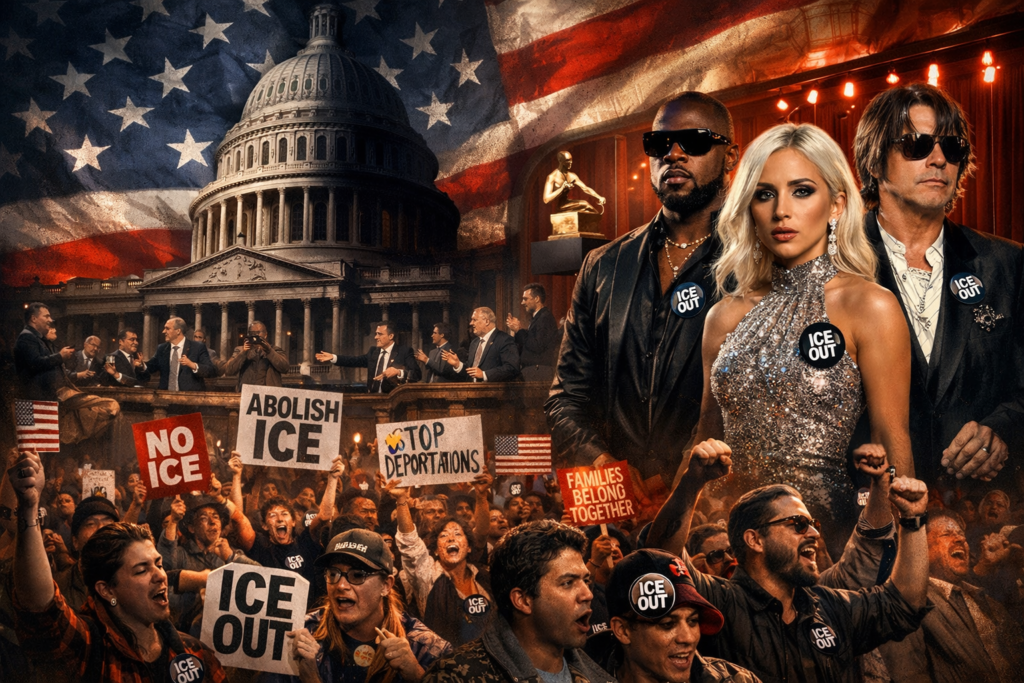
The controversy over ICE did not stay confined to protests and political negotiations. During the 2026 Grammy Awards in Los Angeles, numerous artists used the global stage to protest what they described as harmful immigration policies and enforcement actions by the federal government.
Artists including Billie Eilish, Bad Bunny and Carole King prominently wore “ICE OUT” protest pins on the red carpet and in front of millions of viewers. Their speeches and visuals emphasized humanitarian concerns and solidarity with immigrant communities. Eilish notably declared “no one is illegal on stolen land,” while Bad Bunny used his acceptance speech to call attention to the humanity and dignity of immigrants.
The use of music’s biggest night as a platform for political expression reflects a broader cultural response to federal policy — particularly in entertainment sectors that often embrace social justice causes. Even musicians who did not speak directly used visual symbols of protest, signaling that frustration with current immigration enforcement is spreading beyond traditional activist circles into mainstream culture.
Why This Matters: Politics, Policy and Public Perception
The converging crises — stalled government funding negotiations, nationwide protests against immigration enforcement, and cultural pushback at high-profile events like the Grammys — reveal how deeply immigration and enforcement policy have become central issues in American politics.
For Republican lawmakers, maintaining funding for agencies like ICE is part of a broader commitment to national security and border enforcement. Meanwhile, Democrats argue that continuing to fund the agency without meaningful reforms condones practices they consider abusive or unconstitutional.
The next few weeks in Congress are crucial. Failure to pass a full funding package could trigger a partial government shutdown — disrupting services ranging from defense to public safety — even while ICE operations continue under previously enacted budget authority.
How lawmakers reconcile these pressures — balancing enforcement priorities, civil liberties demands and cultural backlash — could shape the political landscape as the nation heads deeper into 2026 with midterm elections on the horizon.